1. Why the usual instrument returns nothing
Start with what is not in dispute. Project Prometheus was founded in November 2025 by Jeff Bezos and Vik Bajaj, who run it together as co-chief executives [6][7]. It launched with $6.2 billion in initial funding in November 2025 [6]. Its next round, the one the press calls the Series B, was reported in April 2026 at a $38 billion valuation with about $10 billion raised, and then grew as demand to get in rose: it closed in June 2026 at $41 billion, with the raise lifted to $12 billion, a markup of close to eight per cent on the April figure [3][4]. The $38 billion and the $41 billion are not two rounds but one, reported first part-way through and then at its final close. Counting the founding round, more than $18 billion has now been committed in total [3]. The backers are not credulous: JPMorgan, Goldman Sachs, BlackRock, DST Global and Arch Venture, alongside Bezos himself [3].
We are now talking about a company that has freshly raised more than $18 billion. How efficiently it deploys that capital, and toward what, will do as much as anything to determine whether the option grows more valuable over time or quietly expires worthless. One correction at the outset, though, because the numbers move fast and are easy to garble: the $18 billion is the cumulative cash raised across the rounds, not the valuation. The valuation, at the June close, is $41 billion [3].
Now hold that price against what the company has shown the world. There is no product a customer can buy. There is no revenue, because there is nothing yet to sell. There is no registration statement, no audited account, no disclosed forecast. The founders have been, in Bezos's own phrase, "not being secretive," and have still described the work only in outline; they say they spoke now mainly because the story was leaking out and, with this much money raised, "if you let that just be a complete void, they'll fill it with nonsense" [1][2]. Bezos does claim internal progress, benchmarks where some physics simulations run "much faster than you would do with traditional techniques," while declining to detail them and noting the company has been at the work only since late 2024 [2]. That is a signal, not a product. There is still nothing to sell.
This is where most commentary stops, having reached the obvious verdict: a $41 billion price on a company with no measurable fundamentals is absurd, a pure artefact of cheap capital and a famous name. The verdict rests on an assumption so familiar it is rarely spoken, namely that a price must be a discounted estimate of future cash flows, so a price set before any cash flows exist cannot be a real price. For an operating business, that assumption is sound. For Prometheus, it is a category error. The instrument is being pointed at the wrong kind of object.
Because an option has no cash flows either. A call option on a stock pays nothing along the way; it confers the right, not the obligation, to buy something later at a fixed price, in the hope that the something will by then be worth far more. We value options all day long, with no dividends to discount, using a completely different set of instruments. Prometheus, at this stage, is far closer to that object than to a business. The buyers are not paying $41 billion for a stream of earnings. They are paying a premium for the right to own a piece of a company that does not yet exist, on the chance that it becomes enormous. Seen that way, the question stops being "where are the fundamentals" and becomes "is the premium fair for the option."
Most options expire worthless. A few pay for everything else. The discipline is not to pretend you can value the company. It is to admit you are pricing an option, and then to price it honestly.
2. How you actually value an option
Set aside the formulae. The instinct behind option valuation is something any serious investor already carries, and it rests on four questions.
The first is the premium: what you pay to hold the right. The June round prices the whole company at $41 billion post-money, a figure that already includes the $12 billion just raised, which puts the pre-money mark at roughly $29 billion. That $41 billion is the price tag on the option; an investor pays their share of it, and that share is the most they can lose. This is the first and most underrated feature of an option: the downside is bounded by what you paid, while the upside is not.
The second is the payoff: how large the prize is if the bet comes good. For Prometheus the implied prize is the capture of "physical AI," the application of machine intelligence to engineering and manufacturing, a domain its founders describe as effectively the whole made world. A large payoff can justify a large premium even at a low probability, which is the entire logic of venture investing and the entire danger of it.
The third is the probability: how likely the payoff is to arrive. This is where most of the disagreement lives, because no one can compute it. It depends on whether the thesis is right, whether this team executes, and whether the structural plan holds. The work of the rest of this article is to assemble the inputs that move that probability up or down, not to pretend to a number.
The fourth is convexity, the property that makes options worth holding at all. Pay one unit of premium; lose at most that one unit; gain ten or a hundred if it works. A portfolio of such bets can be rational even when most of them fail, provided the rare winner is large enough to carry the losers. This is also, precisely, the argument a buyer of Prometheus is making, whether they say so or not.
Two further inputs colour all of this. Time is an asset to an option: the longer the runway before the bet must be settled, the more chances the thesis has to come good, and Bezos's access to capital buys an unusually long runway. And the quality of the underlying matters more than anything else: an option is only as good as the thing it is a claim on. A call on a serious company in a real market is worth holding; a call on a fantasy is worth nothing at any premium.
So the question "is it worth $41 billion" decomposes into something answerable in parts. Is the premium reasonable for the asymmetry on offer? How good is the underlying, and who controls it? What raises the probability of the payoff, and what lowers it? And is the prize as large as the price implies? Take them in turn.
3. The underlying: a thesis called physical AI
The option is a claim on a thesis, so the thesis is where to begin.
Bezos frames it about as large as a thesis can be framed. Asked to explain the company, he reached past the product to a claim about history: that what drives "the wealth of nations" and "civilizational wealth" is invention, the plough, the steam engine, the solar cell, each of which made everyone richer, and that the goal of Prometheus is to "accelerate that invention loop" [2]. The dream of "an artificial general engineer," he said, is one "people have thought about for decades" and that has never been possible, until, in his telling, now [2].
Prometheus calls its goal an "artificial general engineer" [1][15]. The wager beneath the phrase is what the company calls "physical AI." The models that have absorbed most of the world's capital learn from text and images, from the digital exhaust of human writing. Prometheus's bet is that the more valuable frontier is the physical world, and that an AI which could understand the laws of physics, not merely the patterns in prose, could compress the long and costly cycle from design to manufacture for real objects [3][5]. Bezos's illustration, given to CNBC, is a jet engine: a thing that today takes perhaps a thousand engineers more than a decade to bring from concept to production, which he imagines compressing to five years, or two, or one, and then extending that compression across every hard-engineering field [1]. He offered a sharper version too. The Dutch firm ASML builds the extreme-ultraviolet lithography machines that print the world's most advanced chips; Bezos's question is what happens if ASML could use Prometheus's tools to design its next machines faster, so that the acceleration compounds back up the chain that makes the tools that make everything else [2]. He says he expects the tools to speed engineering workflows "10 times or even more" [1]. The named targets are computing, aerospace, automotive, advanced manufacturing and drug discovery [3]. A useful shorthand, used by several observers, is that the company is trying to build "the CAD of the future" [15]. One clarification, widely misreported, matters: Bezos has been explicit that this is neither a robotics company nor a builder of "world models," and that the speculation it was doing either is simply wrong [2][11]. The product, as conceived, is software for invention, not machines that move.
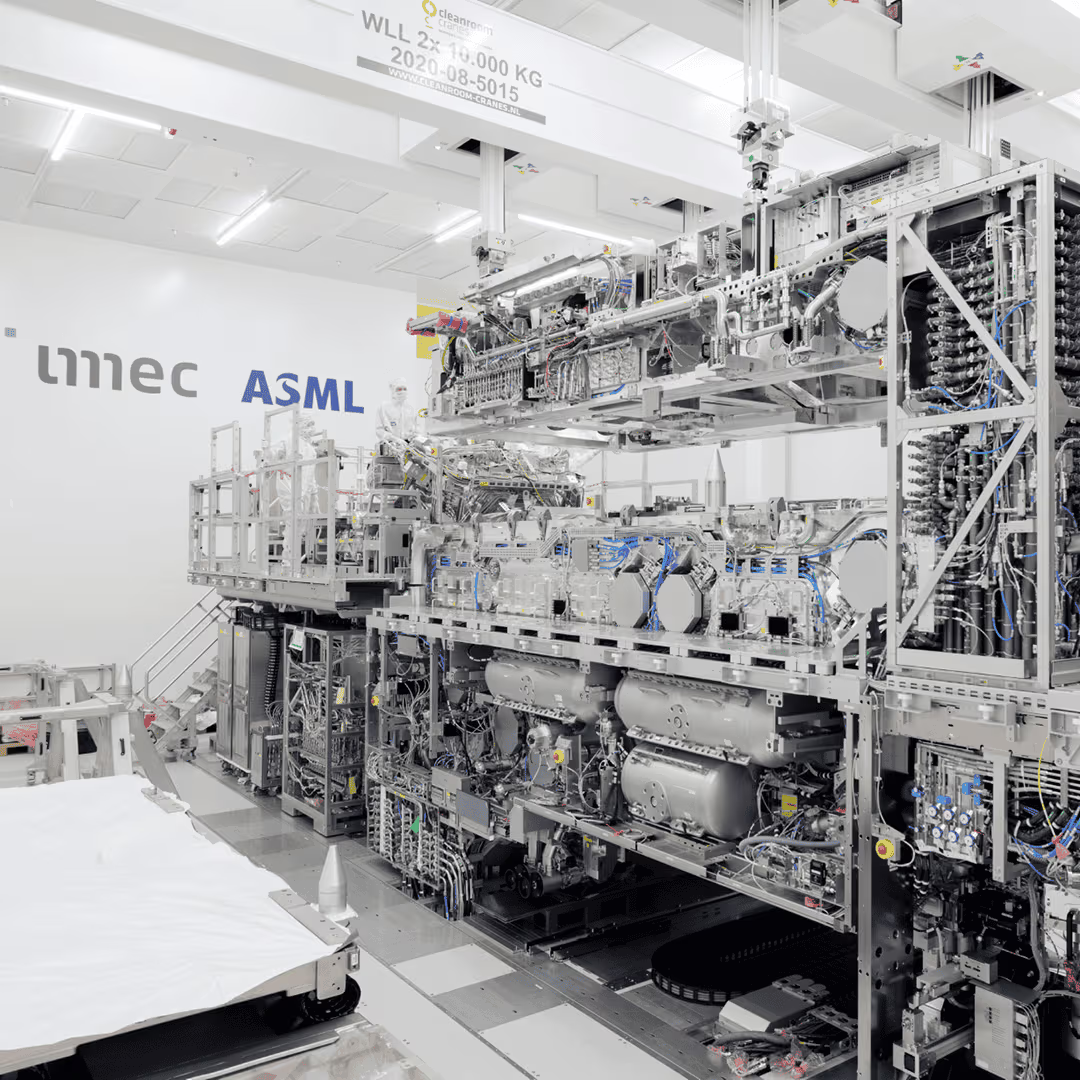
ASML's extreme-ultraviolet lithography machines are among the most complex objects ever built by humans, and sell for prices in the hundreds of millions of dollars. What if Project Prometheus's technology, still to be developed, could one day help cut both the cost and the time of creating the cutting-edge technologies of tomorrow's physical world?
That distinction is worth holding onto, because the obvious comparison invites a category error. The nearest visible analogue for an enormous valuation resting on almost no revenue is Figure AI, the humanoid-robot company, which raised more than $1 billion in September 2025 at a $39 billion post-money valuation, within touching distance of where Prometheus sits today [16]. Figure too has negligible revenue. But Figure has spent years showing its work: successive generations of humanoids demonstrated on video, and early deployments on the line at BMW and in logistics, so an observer at least has something physical to weigh [16]. Prometheus has shown nothing of the kind, which makes its near-identical price the more striking. But the comparison misleads, and on Bezos's own insistence: Prometheus is not a robotics company. He said so flatly, to stop the speculation that it was. Figure is betting on a body; Prometheus is selling the software that designs the body, and the bridges and engines besides. Almost the same price, and not the same kind of thing.
There is a flip side, and it cuts the other way on the valuation. The humanoid field Figure competes in is crowded, and getting more so. Tesla is building Optimus, with more than a thousand units already at work inside its own factories; Agility's Digit is deployed in Amazon and GXO warehouses; Boston Dynamics, now owned by Hyundai, has its all-electric Atlas; China's Unitree is shipping a capable humanoid for around $16,000; and European entrants such as Hexagon and a London start-up named Humanoid have joined the race [23]. A crowded field divides the prize, however large it proves to be. Prometheus, by contrast, has named no direct rival of the same ambition: an artificial intelligence that designs the physical world, rather than a body that moves through it. Whether that is because the idea is genuinely singular, or because no one else yet believes it can be built, is the open question, and a buyer should sit with both halves of it. Scarcity of competition can mean a larger share of the prize. It can also mean the prize is a mirage that only one company can see.
For the option, the thesis sets the shape of the payoff. It is large, coherent, and unproven. It rests on the claim that the methods which worked for language can be made to work for physics, a claim that is plausible, that serious people dispute, and that no evidence can yet settle. That is exactly the profile of an option's underlying: a real possibility, not a certainty, with a wide distribution of outcomes. The premium is being paid for the right tail of that distribution.
4. The quality of the underlying: the man is the strike
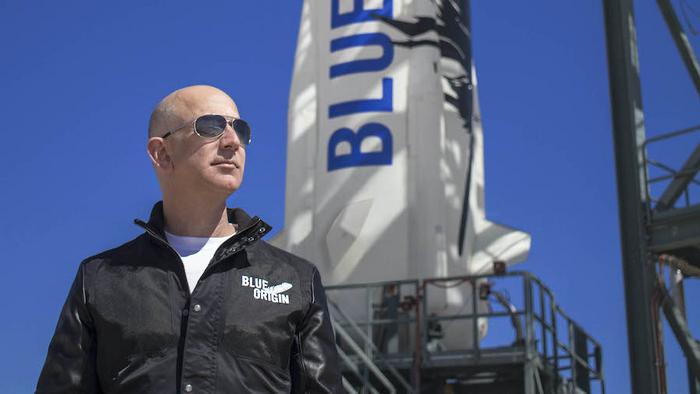
Jeff Bezos in front of a Blue Origin rocket, his space company.
The single largest input into this particular option is not the thesis. It is the person, and honesty requires saying so plainly rather than burying it.
Jeff Bezos built Amazon from a garage bookseller into one of the most valuable companies on earth, and along the way willed two genuinely new industries into being: modern e-commerce logistics, and, through Amazon Web Services, the cloud layer on which much of the present AI boom runs. Prometheus is his first operational role in a technology company since he stepped down as Amazon's chief executive in 2021 [3]. He has said he began as a founding investor in late 2024, became convinced enough that he "couldn't sit on the sidelines," and is now spending the bulk of his time on it [3][9]. His co-founder is not a figurehead: Vik Bajaj is a chemist and physicist who helped build Google X, co-founded Alphabet's life-sciences arm Verily, and ran the incubator Foresite Labs [3][6][7]. The team around them, about 150 people, has been built by hiring researchers away from Meta, OpenAI and DeepMind, and in November 2025 the company quietly absorbed an agentic-AI start-up called General Agents [3][7][12].
It is worth pausing on the pattern, because the pattern is much of what is being priced. Bezos has done this before, more than once. He started Amazon in 1994 selling books by post, turned it into the store that sells everything, and then, in a move almost no one outside the company saw coming, built Amazon Web Services and in effect invented the public cloud, the rented-computing layer that now underpins much of the internet and most of the present AI boom, and that became Amazon's profit engine. In 2000 he founded Blue Origin to try to do for access to space what Amazon had done for retail [13]. Now, in his early sixties, he has taken an operational seat again, to do for engineering what AWS did for computing. The through-line is consistent: enter a capital-intensive, long-horizon, hard-infrastructure domain, spend years and fortunes building the layer beneath an industry, and wait. That temperament is rare, and a large part of the $41 billion is a bet that it carries into a new field.
The record it has produced, though, is not uniform, and an honest valuation splits it rather than averages it. In software, retail and the cloud, it is close to peerless. In the physical world of rockets and engines, which is precisely the world Prometheus has chosen, the same temperament has produced something far more sobering. That asymmetry is the single most important caveat to the bet on the man: the domain where his genius is proven is not the domain his new company has entered.
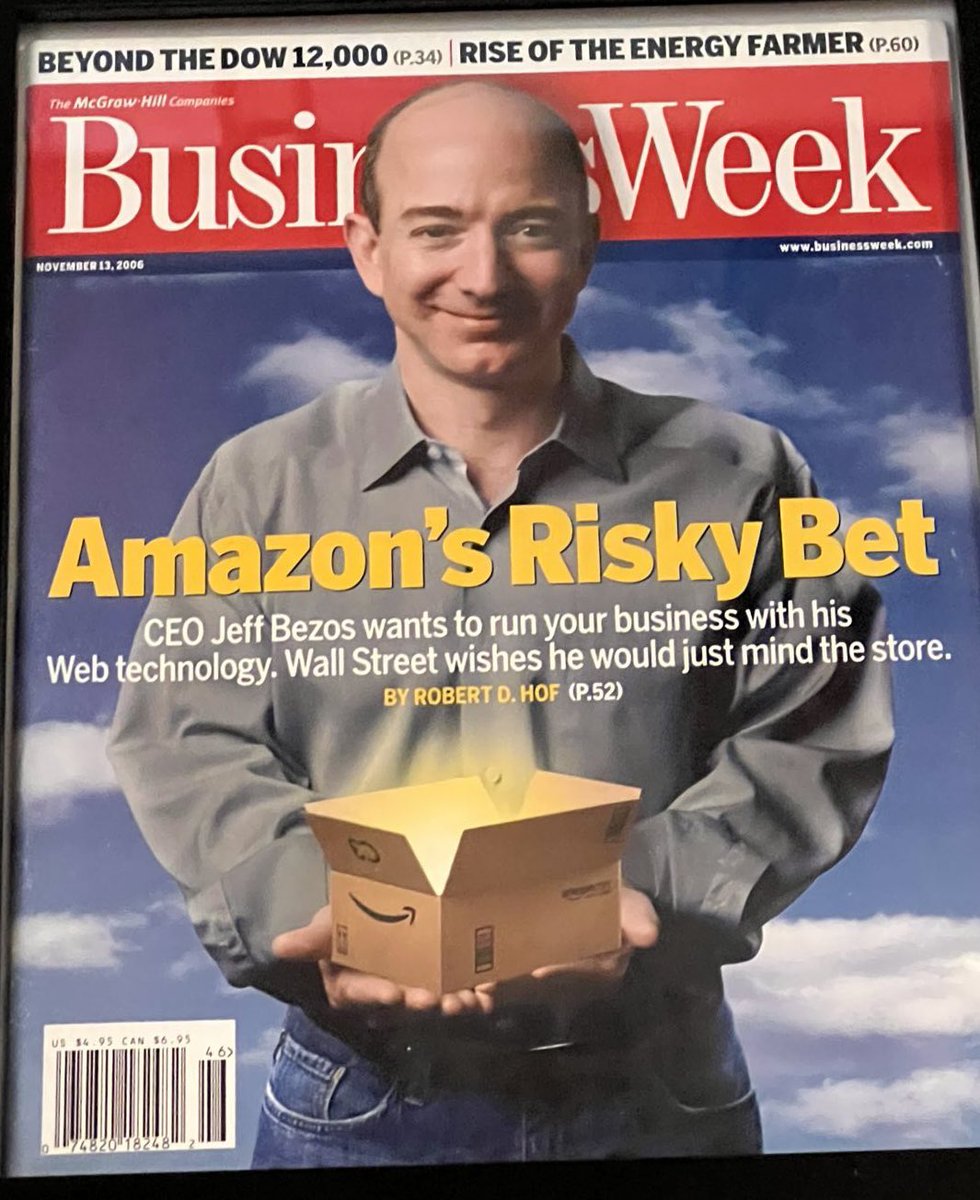
BusinessWeek echoed the scepticism of many observers when Amazon pivoted to develop its AWS cloud business.
In option terms, the founder is the quality of the underlying, and he raises the probability input more than any other single factor. Betting on people is a legitimate and ancient form of investing, and few records in the modern economy support it better. But it should be named for what it is. A large part of the $41 billion premium is not a claim on a business. It is a claim on Bezos's judgement, his ability to recruit, and his access to capital almost no founder can match. The honest bull case is not "the fundamentals justify the price." There are no fundamentals. It is "I am buying a long-dated option on Bezos and Bajaj building something vast in a domain that matters, and $41 billion is the premium for the right to hold it."
And here the option frame issues its hardest warning, aimed straight at that bull case. A famous name with a record of success in one arena, near-limitless capital, and visible, total conviction does not make the new bet pay. The recent past is littered with expensive options held by exactly such people that expired close to worthless. Mark Zuckerberg renamed his company Meta in 2021 to stake it on the metaverse, and Reality Labs has since run up more than $70 billion in cumulative operating losses for a virtual world the public never adopted, even as Meta has quietly redirected its attention to AI [20]. Apple, the most valuable company on earth, with effectively unlimited resources, spent a decade and, by various accounts, on the order of a billion dollars a year on an electric car, Project Titan, and cancelled it in February 2024 with nothing ever shipped [21]. Google, with the deepest research bench in the industry, launched Glass in 2013 to enormous fanfare, including a skydiving demo led by co-founder Sergey Brin, pulled the consumer version in 2015 amid a privacy backlash, and quietly discontinued the project for good in 2023 [22]. None of this says Prometheus will fail. It says the inputs the bull case leans on hardest, the name, the money, the commitment, raise the probability of the payoff; they do not set it to one. The graveyard of options is full of premiums paid by the best.

Jeff Bezos built Amazon from modest beginnings, on a vision of the future that almost no one else shared. This photo shows him in his Amazon office in the company's early days. Will he repeat that success with Project Prometheus?
5. The premium, and how fast it moved
The speed at which the premium has risen is itself a piece of evidence, and it belongs on a single page.
From a standing start to one of the most valuable early-stage companies in the world in roughly seven months, with nothing shipped in the interval [5]. The temptation is to read the curve as pure mania, and section nine gives that reading its due. But read precisely, the curve says something narrower. The $38 billion of April became the $41 billion of June not through any operational milestone, because there was none, but because more capital wanted into the round than there were shares to sell, and the price was marked up to clear it [3]. That is a fact about scarcity and appetite, the same mechanism this publication examined in the SpaceX listing, where demand ran several times the stock on offer. A premium bid up by crowding is information about the queue at the door. It is not a measurement of the option's fair value, and the two are easy to confuse precisely because they arrive wearing the same number.
6. What lifts the option: owning the data
Here the story turns from the familiar to the genuinely unusual, and this, more than the headline price, is the input a serious reader should weigh most heavily, because it attacks the largest single risk to the payoff.
Every account of physical AI hits the same wall: data. Language models had the open internet, the trillions of words of Common Crawl and the public code of GitHub. There is no equivalent corpus for how a turbine is forged, a chemical plant is tuned, or a chip yield is lifted on a real production line [5]. That knowledge exists, but it sits locked inside operating companies as proprietary process data that no one publishes. If the binding constraint on the whole thesis is training data, and the data lives inside industrial firms, then the probability of the payoff turns on a single question: how does a software lab get its hands on it.
Bezos made the point himself, and made it the centre of the company's edge. Unlike the language models trained on "this giant corpus of humanity's knowledge that was already pre-existing on the internet," Prometheus has to "create our data sets and access data sets that are very hard to access," so that "even the training data is completely different" [2]. Asked directly whether that gives him a moat, he answered that it is "very differentiated, because you need access to that kind of data to be able to build a model like this" [2]. The whole bet, in his own telling, rests on getting at data that nobody else can reach.
Prometheus's reported answer is audacious enough to reframe the enterprise. Alongside the lab, Bezos and Bajaj are said to be seeking tens of billions of dollars, in some reports as much as $100 billion, for a separate holding company whose purpose is to buy the industrial businesses the technology is expected to disrupt [7][8]. The Financial Times, which broke the story in February 2026, described a structure that would acquire and operate real-world companies and feed their operational data and physical assets back into the models [8]. The shape is Berkshire Hathaway's, a portfolio of operating industrial businesses, with an explicit artificial-intelligence feedback loop bolted on: own the company, own its data, train the model, improve the company, repeat.
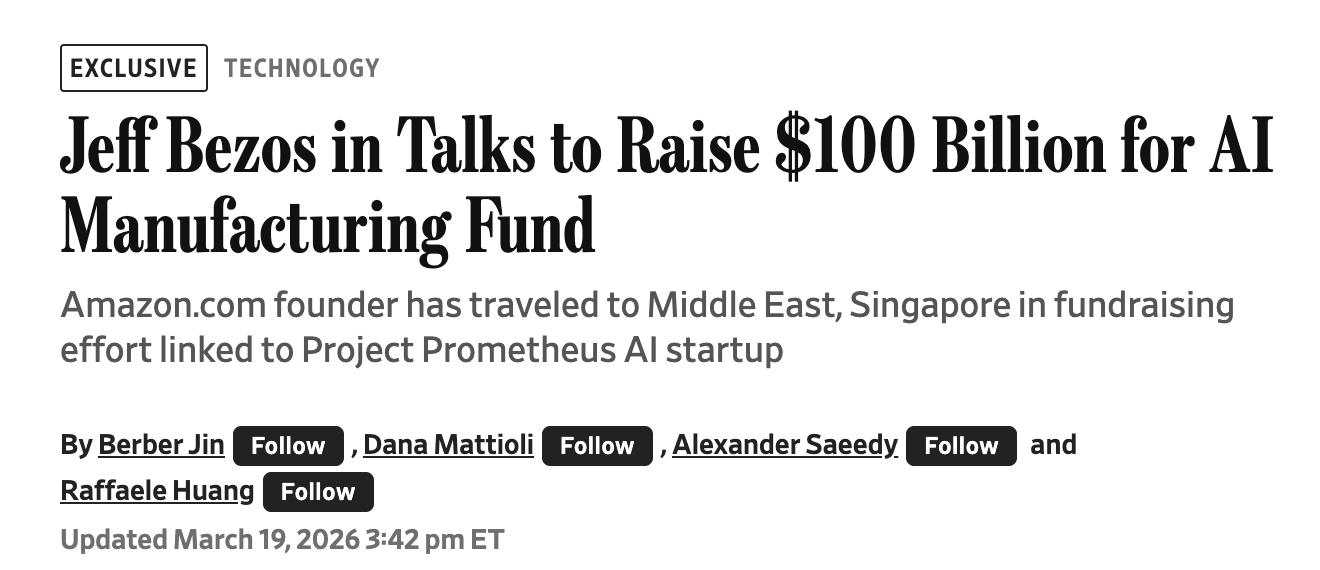
A Wall Street Journal report that Bezos is raising as much as $100 billion for a fund to acquire the industrial companies his technology is meant to disrupt.
In the June interview Bezos confirmed the outline for the first time, and pointedly declined to fill it in. The company "may buy parts of companies" that could benefit from the technology and "then help them improve their processes," he said, before adding that the plan is "still in work" and "premature to talk about" [2]. When Faber put the obvious framing to him, a private-equity-style portfolio of companies onto which the technology is deployed to lift their value, Bezos demurred: "I'm not sure I would frame it that way" [2]. So the structure is real enough to confirm and unsettled enough to keep deliberately vague, which is itself a piece of information: the part of the plan that would most justify the price is the part the founders are least ready to describe.
For the option, this is the input that most raises the probability of the payoff, because it is a direct assault on the thesis's central weakness. It also tells you the buyers are not behaving like fools. They are not paying $41 billion for a design-software start-up. They are buying an early position in something that, if it works, is closer to a new kind of industrial holding company than to a new kind of CAD tool. The premium looks less unhinged once you see the ambition it is attached to, which is not at all the same as saying the ambition will be realised. An option whose success plan requires raising and deploying a further hundred billion dollars is a powerful option and a fragile one in the same breath. And the lab is hungry for capital before the holding company is even built: Bezos says compute and the creation of those bespoke data sets absorb "a big chunk" of the money raised, that the company already has "a lot of compute" and "will actually be needing more," and that this is, in his own words, "a capital-intensive start-up. There's no question about that" [2]. Time, the option-holder's friend, is bought here at a steep and recurring price.
7. What weighs on it: divided attention and an uneven record
An honest option valuation weighs the inputs that lower the probability as carefully as the ones that raise it, and there are two worth naming.
The first is divided attention. Bezos remains executive chair of Amazon, a company with its own vast AI effort and a multibillion-dollar stake in Anthropic. He has floated, in the same breath, opposite futures for the relationship between his new venture and his old one: that hyperscalers including Amazon might use Prometheus's tools to optimise their data centres, and that Prometheus might become a customer of Amazon Web Services for its own compute [10]. Customer, supplier, or competitor: today it could be any of the three, with the same man on both sides of the table. His AI interests also now include the robotics firm Physical Intelligence and the Nvidia-backed Generalist AI, and he continues to fund Blue Origin [3]. He is candid about the split. "Prometheus is the bulk of my time," he told CNBC, "I'm also spending a lot of time on Blue. I'm spending a lot of time on AI at Amazon" [2]. The common thread he names is AI; the uncommon one is that a single man's attention is the scarce input under three large bets at once. When one person co-controls several large entities that transact with one another and compete for the same scarce inputs, capital, talent, chips and his own finite hours, the risk that one venture is run in the service of another is not hypothetical. It is a permanent discount on the underlying, and it should be priced rather than assumed away.
The second is the record itself, in the one domain that matters most here. The case for the option leans on Bezos's genius for building the previously impossible. That genius is real in software and the cloud. In the physical world it is more mixed, and the cleanest evidence is next door.
8. A note on Blue Origin
Blue Origin is Bezos's space company, founded in 2000 and funded for two decades largely by selling Amazon stock, by his own account more than $10 billion of personal capital over the years [13]. Its heavy-lift rocket, New Glenn, can carry roughly 45 tonnes to low Earth orbit, about twice a Falcon 9 [14]. On 28 May 2026 a New Glenn vehicle exploded during a static-fire test at Cape Canaveral, destroying the rocket and badly damaging Blue Origin's only operational pad [13]. In the June interview, his first comments since the failure, Bezos called it "a very bad day for Blue Origin, very tough on the whole team," said the site was being rebuilt, noted the company "got lucky" because the longest-lead-time items survived undamaged, and insisted Blue Origin would be "flying again before the end of this year" [2]. That confidence is worth setting against the NASA administrator, Jared Isaacman, who told CNBC days earlier that restoring the pad could take serious time [2]. The interview aired the morning before the SpaceX listing; asked whether he would watch his rival's record-breaking debut, Bezos said only that he would "be watching along with the rest of you" [2].
Step back, and the comparison with that rival is unforgiving. Blue Origin had the head start, founded in 2000, two years before Elon Musk started SpaceX, and the deeper pockets, Bezos's own [13]. A quarter of a century later the gap runs the other way. SpaceX flew 165 orbital missions in 2025 and is heading for a listing near $1.75 trillion; Blue Origin reached orbit for the first time only in January 2025, landed a New Glenn booster for the first time that November, reused one for the first time in April 2026 (placing its payload in the wrong orbit), and then lost its only launch pad weeks later in the static-fire explosion, with reporting suggesting repairs could take more than a year, against Bezos's insistence on flying again within it [13][14][18]. The technology is genuine: the BE-4 engines Blue Origin builds also power United Launch Alliance's Vulcan, and an enlarged New Glenn and the Blue Moon lunar lander are on the books [14]. But the cadence is not there, and with the pad gone, analysts now expect NASA's lunar programme to depend on SpaceX for the time being [13]. The company is private and discloses nothing, so its worth is guesswork; secondary-market and analyst estimates have run from the tens of billions to as much as $100 billion [17], which even at the top is a sliver of the rival it set out to beat.
There is a reading of all this that is kinder to Bezos, and it is the one that matters most for Prometheus. For almost the entire history of Blue Origin he did not run it day to day. He funded it, by his own account selling around a billion dollars of Amazon stock a year, with cumulative spending now estimated near $28 billion, and he set the vision, but he was Amazon's chief executive until 2021, and the company was run by hired chief executives, most recently Dave Limp from late 2023 [19]. When Bezos interviewed Limp for the job, the question he reportedly asked was whether Blue Origin was "a hobby or a business," which tells you he knew it had been run too much like the former [19]. Musk, by contrast, was a hands-on operator at SpaceX from the first day. The gap between the two companies is, in large part, the gap between a part-time owner and a full-time obsessive. That is precisely why Prometheus differs in the one variable that counts most: this time Bezos is the operator, co-chief executive, in his own words "in with both feet" [2]. For the option, it cuts both ways. It raises the probability, because the absentee-funder failure mode is the one he has visibly chosen to avoid. And it concentrates the risk, because his full attention is now the scarce input, and he has just told us it is divided three ways.
All of this belongs in an option valuation for one reason. The probability input for Prometheus is being set largely by Bezos's record as a builder of hard physical-engineering companies, and Blue Origin is what that record looks like up close: real technology, enormous spending, and, after twenty-five years, a follower rather than a leader. The domain Prometheus has chosen, the physical world, is precisely the one where the founder's record argues for humility rather than certainty. A disciplined buyer marks the probability down accordingly, without pretending the down-mark is a number.
9. Is the premium itself in a bubble?
There is a question the option frame raises that the founder has answered himself, with unusual candour, and it deserves examination rather than applause.
Asked in May 2026 whether the AI build-out is a bubble, Bezos did not deny it. He argued it does not matter. "Even if it does turn out to be a bubble," he said, "you shouldn't worry about it, because the bubble is driving investment, and a lot of the investment is going to turn out to be very healthy" [9]. Investors, he went on, "haven't learned yet how to discriminate between good ideas and bad ideas, and that's okay, because the good ideas will pay for all of the losers" [9]. His analogue was the biotech boom of the 1990s: a frenzy that destroyed a great deal of capital and still left behind life-saving drugs that outlived the investors who lost money funding them [9].
This is, in fact, an argument about convexity, made at the level of the whole system. Across a portfolio of options, the winners pay for the losers, so the aggregate is rational even when most bets fail. As social observation it is plausible; bubbles have financed durable infrastructure from the railways of the 1840s to the fibre of the 1990s. But notice what it does for the speaker, and where it leaves the listener. "The good ideas will pay for the losers" is true for the system and silent about your own premium. The investors who funded the biotech losers did not keep the drugs; the public did. Convexity protects a diversified portfolio of options. It does nothing for a single option bought at too high a premium. The reader should separate the two claims Bezos has elegantly merged: that AI investment in aggregate is socially productive, which is likely, and that this option at this premium is sound, which is exactly the question his venture poses and does not answer.
10. The size of the prize, and the oldest trick in valuation
The last input is the payoff itself, the size of the prize, and it is the one every bull case leans on hardest.
Taken at their word, the founders' addressable market is the physical economy as such. Bajaj put a number on it without prompting: Prometheus is "one small company operating in a physical economy, which amounts to 60% of the world's GDP. It's very large, it's $70 trillion" [2]. Against a prize of seventy trillion dollars, $41 billion can be made to look not merely reasonable but small, which is exactly why the framing gets reached for, and here it is the founders themselves who reach for it.
This is where the Socratic flag goes up, because a total addressable market that is the whole economy is the oldest trick in the valuation book. It was used for the internet, where it was broadly right, and for scores of companies that captured none of it, where it was fatal. The size of a market sets the size of the prize. It says nothing about which firm captures it, what share, at what margin, or when. For an option, the prize is only the upside leg; it has to be multiplied by a probability the framing quietly sets to one. A claim on "all of physical engineering" is worth a great deal if Prometheus becomes the indispensable layer beneath it, and very little if it becomes one of several tools competing for a slice. The prize is real. The leap from a real prize to a justified premium is the entire question, and it is a leap the number $41 billion makes silently, before any product exists to test it. To their credit, the founders said as much themselves. In the same breath as the seventy-trillion-dollar figure, Bezos insisted: "we need to be very humble about this. This is very early. This is not a done deal" [2]. The option price has to hold both statements at once, the size of the prize and the honesty about the odds, which is exactly what a premium is for.
11. Pricing the option: the questions worth answering
So, is Project Prometheus worth $41 billion? The most useful answer is that the question, asked that way, has no answer, because you cannot point-estimate an option and call the estimate a value. What you can do is the thing every option buyer does: decide whether the premium is justified by the asymmetry, given inputs that only you can supply.
What survives examination is roughly this. The sceptical objection is right that no fundamental analysis supports the number, and wrong to conclude the number is therefore irrational; at the frontier, some prices are option premiums, not valuations, and the right instrument is the one used for options, which the consensus is not using. The premium is large and has been bid up by crowding rather than by progress. The quality of the underlying is unusually high, because the underlying is, in large part, Bezos. The input that most raises the probability of the payoff is the reported plan to own the industrial data by owning the companies, which is genuinely novel and genuinely hard. The inputs that most lower it are divided attention and a physical-world record that is strong but uneven. And the prize, described as everything, is the upside leg of the option with the probability quietly set to one.
This publication does not tell you what to conclude. It hands you the instruments. Before deciding what a seat in this round is worth to you, price the option honestly, and the questions are these. What probability, in your own estimate, do you put on physical AI being the next great domain rather than the next great extrapolation that does not arrive? How much of the premium is the thesis, and how much is simply Bezos, and are you comfortable paying for a man whose attention is divided across an empire? Is the real underlying the lab, or the conglomerate the lab is meant to feed, and have you priced the second rather than the first? And when the prize is described as the whole made world, what share do you honestly expect this firm to hold, at what margin, and in what year? An option is only ever worth the asymmetry between what you pay and what you might gain, weighted by a probability no one can hand you. Supply those inputs yourself, and the question of whether $41 billion is mad or merely early will have begun to answer itself, in whichever direction your own examination takes it.
Socrates on Investing is an editorial publication. It is not investment advice, not a service, and not a solicitation. The full disclaimer appears at the top of this article.
Sources
- CNBC, "Bezos opens up about AI startup Prometheus after $12 billion raise: 'We're not being secretive,'" 11 June 2026. https://www.cnbc.com/2026/06/11/project-prometheus-bezos-bajaj-live-updates.html
- CNBC, "Transcript: Prometheus Co-Founders and Co-CEOs Jeff Bezos and Vik Bajaj Speak with CNBC's David Faber on 'Squawk on the Street,'" 11 June 2026. https://www.cnbc.com/2026/06/11/cnbc-exclusive-transcript-prometheus-co-founders-and-co-ceos-jeff-bezos-and-vik-bajaj-speak-with-cnbcs-david-faber-on-squawk-on-the-street-today.html
- The Next Web, "Bezos's Prometheus raises $12 billion at $41 billion valuation to build AI that engineers physical products," 11 June 2026. https://thenextweb.com/news/bezos-prometheus-ai-41-billion-valuation-12b-raise
- Bloomberg, "Bezos's Physical AI Lab Has Closed Round at $38 Billion Value," 23 April 2026. https://www.bloomberg.com/news/articles/2026-04-23/bezos-s-physical-ai-lab-has-closed-round-at-38-billion-value
- Tech Funding News, "After a $10B raise, Project Prometheus becomes one of the most valuable five-month-old startups ever funded," 24 April 2026. https://techfundingnews.com/project-prometheus-bezos-funding-38b-valuation-physics-ai/
- Cade Metz, "Jeff Bezos Creates A.I. Start-Up Where He Will Be Co-Chief Executive," The New York Times, 17 November 2025. https://www.nytimes.com/2025/11/17/technology/bezos-project-prometheus.html
- "Project Prometheus (company)," Wikipedia. https://en.wikipedia.org/wiki/Project_Prometheus_(company)
- George Hammond, Cristina Criddle and Rafe Rosner-Uddin, "Jeff Bezos's $30bn start-up seeks tens of billions to buy industrial companies disrupted by AI," Financial Times, 26 February 2026. https://www.ft.com/content/7b1bdc9d-c857-4ec9-91b4-fb4f6dd2e43b
- CNBC, "Bezos brushes off concerns of an AI bubble: 'You shouldn't worry about it,'" 20 May 2026. https://www.cnbc.com/2026/05/20/bezos-ai-bubble-concerns-amazon-prometheum-blue-origin.html
- Crypto Briefing, "Jeff Bezos floats potential partnership between his AI startup Prometheus and Amazon for data center optimization," June 2026. https://cryptobriefing.com/bezos-prometheus-amazon-data-center-partnership/
- GeekWire, "Jeff Bezos describes his $38B startup Prometheus for the first time: 'Nothing to do with robotics,'" 2026. https://www.geekwire.com/2026/jeff-bezos-describes-his-38b-startup-prometheus-for-the-first-time-nothing-to-do-with-robotics/
- Wired, "Jeff Bezos' New AI Venture Quietly Acquired an Agentic Computing Startup," 26 November 2025. https://www.wired.com/story/jeff-bezos-new-ai-company-acquired-agentic-computing-startup/
- Fortune, "After Blue Origin rocket explosion, NASA's entire moon exploration program depends on SpaceX for now," 30 May 2026. https://fortune.com/2026/05/30/blue-origin-new-glenn-explosion-nasa-artemis-moon-exploration-program-spacex-musk-ipo/
- "New Glenn," Wikipedia. https://en.wikipedia.org/wiki/New_Glenn
- Inc., "Jeff Bezos' Prometheus Just Raised $12 Billion to Create an 'Artificial General Engineer.' Here's What That Would Do." https://www.inc.com/chloe-aiello/jeff-bezos-prometheus-just-raised-12-billion-to-create-an-artificial-general-engineer-heres-what-that-would-do/91359870
- Figure AI, "Figure Exceeds $1B in Series C Funding at $39B Post-Money Valuation," September 2025; and TechCrunch, "Figure reaches $39B valuation in latest funding round," 16 September 2025. https://www.figure.ai/news/series-c
- Blue Origin Enterprises, private-company profile and secondary-market valuation estimates, PitchBook and Proactive Investors, 2024-2026. https://pitchbook.com/profiles/company/56325-79
- "New Glenn," Wikipedia; and Space.com, "Blue Origin reuses huge New Glenn rocket for 1st time, lands booster at sea, but deploys satellite into wrong orbit," 19 April 2026. https://www.space.com/space-exploration/launches-spacecraft/blue-origin-reuses-new-glenn-rocket-landing-success-1st-time-on-april-19-2026-video
- GeekWire, "Departing Amazon exec Dave Limp will take over from Blue Origin CEO Bob Smith," 25 September 2023 (including Bezos's 'hobby or a business' question); and The Motley Fool, "How Much Is Billionaire Jeff Bezos Spending on Blue Origin?", 21 September 2024. https://www.geekwire.com/2023/departing-amazon-exec-dave-limp-will-take-over-from-blue-origin-ceo-bob-smith/
- CNBC, "Meta's Reality Labs lost over $4 billion in first quarter," 29 April 2026; cumulative Reality Labs operating losses since 2020 now exceed $70 billion. https://www.cnbc.com/2026/04/29/metas-reality-labs-lost-over-4-billion-in-first-quarter.html
- TechCrunch, "Apple cancels its autonomous electric car project and is laying off some workers," 27 February 2024. https://techcrunch.com/2024/02/27/apple-cancels-electric-car-project-titan/
- "Google Glass," Wikipedia; and CNBC, "Google discontinues Google Glass Enterprise, end to early AR project," 15 March 2023. https://www.cnbc.com/2023/03/15/google-discontinues-google-glass-enterprise-end-to-early-ar-project.html
- On the humanoid-robotics landscape (Tesla Optimus, Agility Digit, Boston Dynamics Atlas, Unitree, and European entrants including Hexagon and Humanoid): EVST, "Top 8 Humanoid Robot Companies to Watch in 2026," and Standard Bots, "Top 12 humanoid robotics companies to watch in 2026," 2026. https://www.evsint.com/top-8-humanoid-robot-companies-2026/