1. The verdict before the inquiry
The consensus among finance professionals seems to be deeply sceptical, and it is easy to see why. So many of them argue that the valuation makes little sense relative to the company's fundamentals: a business that generated about $18 billion of revenue in 2025 and still lost money [1] is asking public markets for roughly $1.75 trillion [2], which would make it one of the most valuable companies in the world before it has traded for a single minute. Morningstar puts fair value near $780 billion, less than half the target [3]. One prominent analyst has told subscribers, in plain words, to avoid the offering, calculating that the price implies the company must eventually reach something like $1.1 trillion of revenue and $248 billion of net profit to make sense [4]. The structure of the deal draws its own doubts: a price reportedly set by the founder rather than discovered through a normal bookbuild, a small free float, and a path into the Nasdaq 100 only fifteen trading days after listing that would oblige index funds to buy whatever the price [5]. A common worry is that this is a “fandom listing,” priced for believers and for the machines that track an index, and that many of those paying $135 a share [2] may be underestimating how much has to go right.
At roughly $1.75 trillion, SpaceX would rank as the seventh most valuable company in the United States, just behind Broadcom and ahead of Meta and Tesla (see the chart below). Compare the group instead on market value divided by 2025 revenue, and SpaceX stands apart: at about 94 times sales it is by far the most expensive name on the board, well above the next, Nvidia, at 37 times.
There is a great deal of truth in that picture, and this piece will not pretend otherwise. But scepticism, however widely shared, is not the same as analysis, and a number that unsettles is not therefore wrong. If you dig slightly deeper, you can quickly see a different reality. SpaceX recently announced two massive contracts to offer computing power to Anthropic and Google to power AI. We are talking about $1.25 billion per month through May 2029 for Anthropic and $920 million per month through June 2029 for Google. The sum makes $26 billion per year from two new contracts compared to $18 billion in overall revenue for the whole company last year. That massively changes the analysis and show how SpaceX revenue trajectory has nothing in common to a standard company. You remember the 94x multiple ? If we take into account these two contract and add a big of growth from other business, we could speculate on a current $50 billion revenue run rate that would make the multiple shrink to 35x, now in line with NVIDIA.
The interesting question is not whether $1.75 trillion is a lot of money. It is. The interesting question is what that number is a claim on, whether the instrument the sceptics are using to measure it actually measures the thing, and where, once the first reaction has been set aside, the real reasons for caution turn out to lie. So let us dig deeper, and go a little further than the headline.
2. What you are actually buying: the three businesses inside SpaceX
Pricing SpaceX begins with refusing the single-number summary. The company reports in three segments, and they could hardly be more different in character. In 2025 the Connectivity segment, essentially Starlink, generated $11,387 million of revenue, about 61% of the total, with $4,423 million of income from operations; the Space segment, the launch and Starship business, generated $4,086 million, about 22%; and the AI segment, acquired with xAI in February 2026, generated $3,201 million, about 17%, while losing money heavily [1]. Consolidated revenue was $18,674 million and the net result was a loss of $4,937 million [1], yet the company earned a $791 million profit as recently as 2024 [1]. The loss is not the sound of a failing business. It is one profitable company paying for the construction of another.
The chart below sets out SpaceX's reported revenue for 2023 to 2025 alongside my estimates for 2026 and 2027, which I have built from analysts' forecasts for the three segments the company runs today. Artificial intelligence and compute is where growth is expected to be strongest in the next few years, though connectivity (Starlink) is modelled to keep climbing hard as well, from about $11 billion in 2025 toward $30 billion by 2027.
The launch business is the part the public knows. Falcon 9 and Falcon Heavy are the reusable workhorses that collapsed the cost of reaching orbit, against a historical industry average the prospectus puts near $18,500 per kilogram [1]. Reusability turned launch from a craft into something closer to a schedule, which is why SpaceX now carries the overwhelming majority of the world's payload to orbit. Starship is the next generation: a fully reusable vehicle designed to lift far larger payloads at a small fraction of today's cost, and the intended means of deploying both the newest Starlink satellites and, later, compute hardware in orbit [1]. Falcon pays the bills today; Starship is the wager on the cost curve falling further still.
Starlink is the profit engine, and the business most investors underrate. It sells broadband from low orbit on subscription, and it has scaled to roughly ten million subscribers across more than 160 markets, at operating margins a traditional telecoms operator would envy [1]. Average revenue per user has actually fallen, toward the mid-sixties of dollars per month, as the service expands into lower-income geographies [1]; that is a volume strategy, not a weakness, because each new generation of satellite, carried up by Starship, adds a large multiple of network capacity. Starlink is what makes the consolidated loss bearable, because it funds everything else.
The newest business is the one changing fastest, and the one most misread. SpaceX acquired xAI in February 2026, and the asset everyone names is Grok, the chatbot. In practice the value has shifted from the model to the machine beneath it: COLOSSUS and COLOSSUS II, the gigawatt-scale data centres in Memphis and Mississippi that the company calls the first coherent training clusters of their kind [1]. Increasingly SpaceX is not selling Grok; it is selling compute, the raw capacity those data centres represent. That is a different and, for now, larger business than the consumer AI product, and it is why the AI segment is at once the smallest in revenue and the largest in appetite for capital.
And the speed of the buildout turns the usual scepticism about execution on its head. The original Colossus in Memphis went from an empty building to a 100,000-GPU training system in 122 days, against the eighteen to twenty-four months such a project would normally take, then doubled to 200,000 GPUs in a further 92 days [15]. Nvidia's Jensen Huang called the pace “superhuman” and described Musk as singular in marshalling engineering and resources at that scale [15]. The second-generation site, Colossus II, spanning Memphis and Southaven in Mississippi, is being scaled toward two gigawatts of power and on the order of 555,000 GPUs, which would make it the largest single-site AI data centre in the world [16]. This matters for valuation more than it first appears: in AI, the binding constraint is not ambition but the ability to actually build and power compute at scale, and SpaceX has just shown it can do that faster than anyone.
How much can that capacity earn? The company runs it on a dual model. Part is used internally, to train its own frontier model, Grok 5, at Colossus II [1]; the rest is sold to outside customers. In May 2026 SpaceX agreed to sell capacity to Anthropic for $1.25 billion per month through 2029, and shortly after to Google for about $920 million per month from late 2026, the latter for roughly 110,000 Nvidia processors [1][6]. Those two external contracts alone annualise to about $26 billion [8], more than the entire company earned in 2025, and analysts following the roadshow have sketched a revenue run rate near $60 billion by the end of 2026, roughly triple the prior year [8]. A site that can be filled this quickly and monetised across internal training, Anthropic, and Google at the same time is the clearest measure of how much is potentially on the table here, and how fast.
A single customer shows what “selling compute” now means. Cursor, an AI coding tool whose annual recurring revenue raced from about $100 million at the start of 2025 to roughly $2 billion by February 2026 [25], signed a compute agreement with SpaceX in April 2026. The arrangement is unusual. SpaceX did not simply sell Cursor capacity; it also took an option, a right rather than an obligation, to acquire the company outright at an implied equity value of $60 billion, payable in its own shares [1]. And the customer is itself valued on the very bet on an AI future that underwrites SpaceX's price, so the same enthusiasm sits on both sides of the contract, a circularity worth keeping in view.
3. The factory behind the forecast
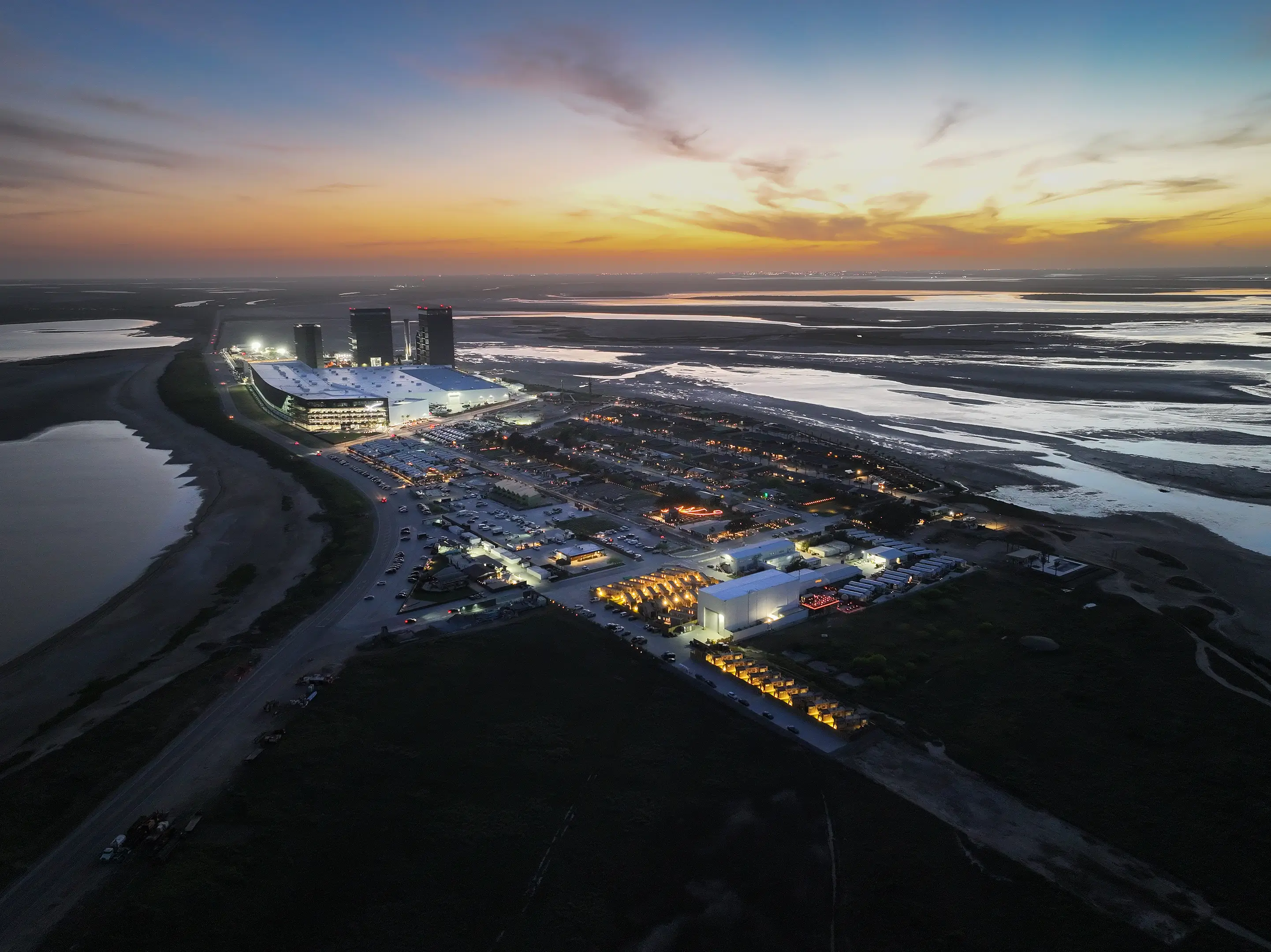
Starbase, on the Texas coast: SpaceX's launch and production city, home of the Starfactory.
Every number in the section before this one lives on a model, and models are cheap. Anyone can type fifty billion dollars into a cell. The harder question, the one that separates a real claim from a hopeful one, is whether the physical capacity exists to make those numbers happen, because revenue at this scale is not conjured from a forecast: it is produced by buildings, machines, launch pads and power. This is where SpaceX is genuinely unusual. It is not, at heart, a financial structure or a set of projections; it is a builder, and its ambitions are credible only to the extent that the infrastructure to execute them already stands. On that test it is hard to fault. The compute revenue from Google and Anthropic that so changed the picture is not a promise of data centres to come; it is sold out of Colossus, the largest AI supercomputer on Earth, already running at two gigawatts [21]. The rockets that lift Starlink to orbit are not a roadmap; SpaceX flew 165 of them in 2025, more than the rest of the world put together [22]. Before judging what the company might earn, it is worth looking at what it has already built.
Start with the ground itself. In May 2025 the company's launch and production site on the Texas coast voted to incorporate as a city, Starbase, the first new city in its county in three decades [23]. The name matters less than what sits inside it: Starfactory, a plant built not to make rockets one at a time but to mass-produce them, turning raw stainless steel at one end into finished Starships at the other, with peak output planned at roughly one ship a day [23]. A second hall, Gigabay, a quarter-billion-dollar assembly building, is rising alongside it, designed to turn out up to a thousand vehicles a year, with Musk talking of ten thousand in time [23]. Those last figures are ambition, not fact, and should be read as such. But the principle is the unusual part. Most companies buy capacity; SpaceX builds the factory that builds the product, the same vertical-integration instinct that took the cost of a Falcon booster down by reusing it rather than discarding it.
The clearest proof that this is a building company, not a slide deck, is Colossus. We met it in the previous section, but it bears repeating: with around five hundred and fifty-five thousand GPUs across two gigawatts of power, it is four times the size of the next-largest dedicated AI site and the largest such machine on Earth [21].
The same is true one layer down, at the part of the company the public still pictures when it hears the name. In 2025 SpaceX launched 165 orbital rockets, a record, a sixth straight record year, and roughly the same number as the entire rest of the world combined, with individual boosters now flying twenty times and more [22]. That cadence is not a vanity statistic. It is the moat under Starlink: a constellation only pays if you can put satellites in orbit cheaply and often, and no one else on the planet can do it at this rate or this price. The launch business that looks small on the revenue line is the thing that makes the large business above it possible.
The build does not stop at what is already running. The AI unit has described a “terafab” with Tesla and Intel meant to manufacture compute hardware at the scale of a terawatt, and the company has filed for a constellation of orbital data-centre satellites and flown the first of them, with deployment intended from 2028 [20][17]. Whether those projects arrive on time, or at all, is genuinely unknown, and the section that follows treats them as options rather than plans. The point here is narrower: the same organisation that is talking about chips in space is the one that has already poured the concrete in Memphis and Texas. Its forward promises sit on a record of having built the last impossible thing on schedule.
It is worth asking where the money actually goes. The S-1 says the proceeds will fund the growth strategy, AI compute, launch infrastructure and the expansion of the satellite constellations, with the remainder for general corporate purposes [1]; but a large share of the roughly $75 billion is committed before it arrives. SpaceX took on a $20 billion bridge loan in March 2026 to absorb xAI's debt in the acquisition, repayable within six months of the listing, and further sums are owed to EchoStar for spectrum, so by one analysis around three quarters of the proceeds is already spoken for and under $18 billion is genuinely new growth capital [24]. The raise funds the infrastructure, in other words, but it also settles the bill for having built it.
None of this settles the valuation. Infrastructure removes one risk, the risk that the company simply cannot build what its forecasts assume, and for SpaceX that risk is unusually low. It does not remove the others. Demand could soften, the economics of selling compute could erode as capacity floods in, the contracts could be cancelled, the launch advantage could narrow. What the infrastructure changes is the question. For most companies pitched at $1.75 trillion, the doubt is whether they could ever build the thing. For SpaceX, the thing is largely built, and the doubt moves to whether the world will want as much of it, for as long, and at as good a price, as the model assumes. That is a different and more interesting argument, and it is the one the rest of this piece goes on to have.
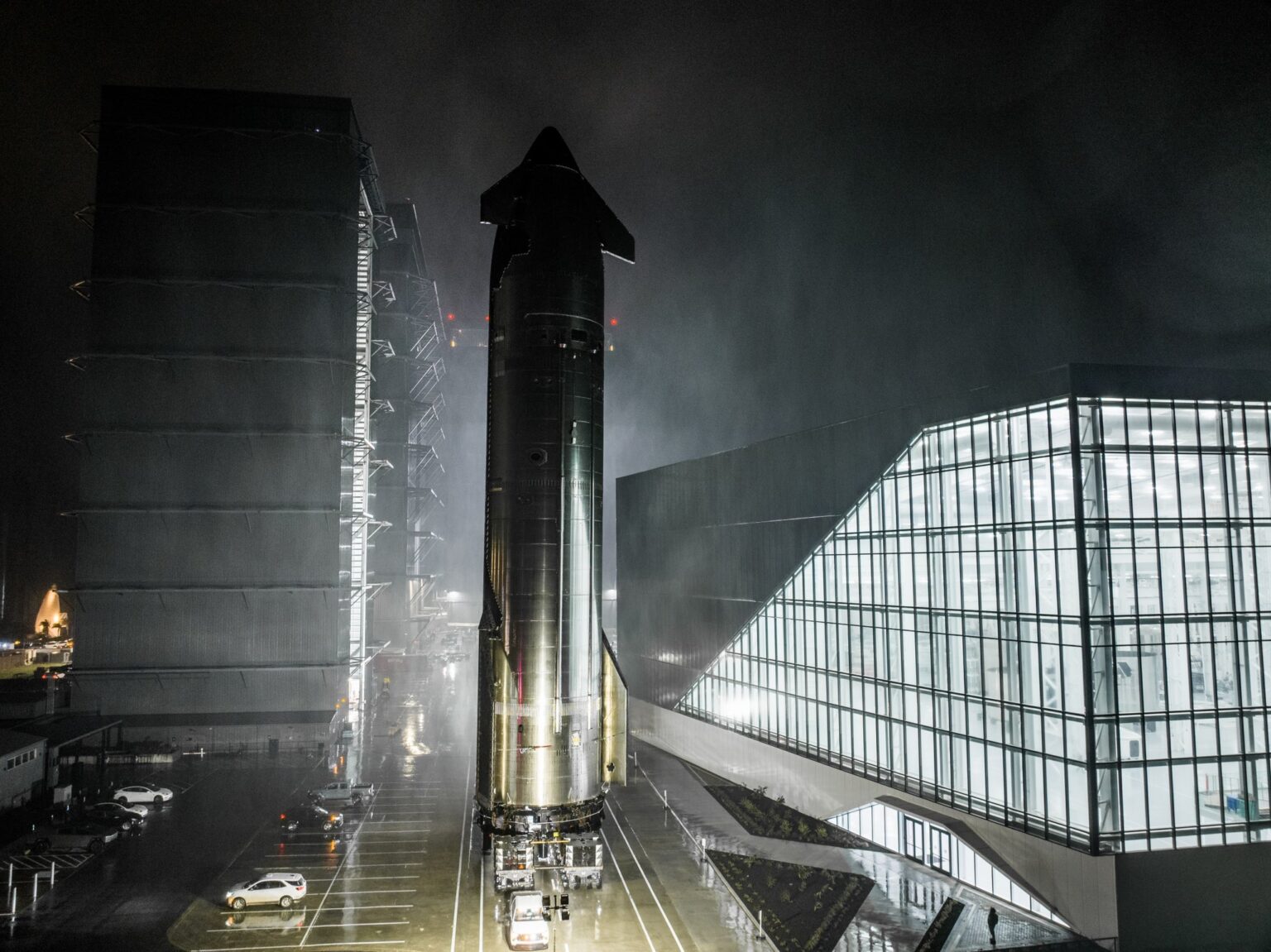
Starship, the fully reusable upper stage. Its third version flew for the first time in May 2026, on the programme’s twelfth test flight; the vehicle is still in testing and is not yet carrying commercial payloads. It is designed to lift more than 100 tonnes to low Earth orbit, against roughly 35 tonnes for the previous version, with SpaceX citing up to 150 tonnes [33]. Today’s workhorse is Falcon 9, the most-flown rocket in the world, which carries about 22 tonnes to that orbit at a higher cost per kilogram. If rapid reuse works as intended, Starship could push the cost of reaching orbit toward a few hundred dollars per kilogram, and on SpaceX’s stated target eventually below $100, against roughly $2,700 per kilogram on Falcon 9 today [34]. These are design goals, not yet demonstrated.
4. The options on the future
Beyond the three lines that earn money today sits a long pipeline of things SpaceX might also become, and this is where valuation stops being arithmetic and starts being judgement. The company's ambitions run from the near and concrete to the distant and fantastical, so the honest way to look at them is in order of when they might plausibly arrive. One principle should be fixed before we start: options have value. Most expire worthless, and some of these will; but a few become the thing that reaches the stars, or in this company's case Mars, and a single one paying off can dwarf everything paid for it. This is the most speculative part of any valuation, and anyone who claims precision here is selling something. The opposite error is just as real, though. Assigning these options a value of exactly zero is not caution; it is its own confident forecast, that nothing new works, and for a company with this record of building, that is a strange thing to be sure of. What follows attaches rough odds to each, not to predict, but to make the guessing explicit. Elon Musk recently gave a wide-ranging interview on where SpaceX is headed; it sits just below, and it is worth watching before going on.
Nearest, and most probable, are the extensions of what already runs. The compute business has years of contracted demand and physical capacity ahead of it, and the first orbital data-centre satellite has already flown, with deployment intended from 2028 [17]. Starlink keeps adding subscribers and is moving into direct-to-cell, turning an ordinary phone into a satellite terminal. Starship, once it reaches a reliable operational cadence, replaces Falcon as a cheaper and larger workhorse and unlocks much of what sits above it. And there is a United States Department of Defense programme to use Starship to move a hundred tonnes of cargo point to point across the Earth in under an hour [20]. None of these is certain, but each is an improvement on a business that already exists, with customers or contracts attached. Call them more likely than not.
In the middle distance sit the harder bets. SpaceX is under contract to NASA as the lander meant to return astronauts to the Moon, with orbital tests around 2027 and a crewed landing targeted for 2028 [18]. The AI unit has described a terafab with Tesla and Intel to manufacture compute hardware at the scale of a terawatt [20], which would turn SpaceX from a buyer of chips into a maker of them. And the orbital data-centre constellation, filed for at up to a million satellites, would move serious computing off the planet entirely [17]. Each has real money and real engineering behind it, but each also depends on something difficult going right on schedule. Plausible, not probable.
Furthest out are the moonshots in the literal sense. Mars is the company's stated purpose, though even Musk has pushed the first crewed attempts back by years [19]. Beyond it lie things only sketched: manufacturing in orbit, mining beyond Earth, power generated in space, and the projects no one has named yet. Taken individually, each is a long shot, and most will not happen on any timeline that matters to a buyer today. But this is exactly where option value lives: a low probability against a payoff so large that even a small chance is worth something. You do not pay full price for Mars. You pay a little, and you notice that the company trying it is the one that has already done the last several impossible things.
None of this can be priced with a straight face, and this piece will not pretend to. The point is narrower. The $1.75 trillion is not only a claim on three businesses and their forecasts; it is also a portfolio of options on futures that may never arrive. A careful reader should resist two temptations: to count the moonshots as if they were plans, and to count them at zero as if they were impossible. The disciplined position is in between, holding them as what they are, low-probability and high-payoff bets attached to the one company with a habit of winning them, and sizing them accordingly.
5. The price nobody discovered
One of the strongest objections to SpaceX's valuation is purely procedural. The valuation, critics say, was effectively set by Musk and presented to the banks rather than discovered through a competitive bookbuild, the float is small, and a quirk of Nasdaq's revised methodology means the company could enter the Nasdaq 100 only fifteen trading days after listing, forcing index funds and the retirement accounts that track them to buy regardless of price [5]. The word being used is that there has been no real price discovery.
It is worth examining what that phrase assumes. The implicit belief is that a normal IPO bookbuild produces a “true” price and that its absence produces a false one. But bookbuilt IPOs are not a truth machine. The history of the last three decades is full of conventionally bookbuilt offerings that opened at prices later revealed to be far too high, and of others left far too cheap, with the difference captured by the favoured institutions allocated stock the night before. Direct listings exist precisely because some issuers concluded the bookbuild was a poor mechanism for finding a price. So the absence of a bookbuild is a genuine reason for caution, but not for the reason usually given. The risk is not that the price lacks some metaphysical truth a bookbuild would have conferred. The risk is concrete and microstructural: a small float plus forced index demand can hold a price aloft for a while regardless of fundamentals, which means the early trading price may tell you even less than usual about what the business is worth. That cuts against the buyer, not the seller. It is an argument for patience and for ignoring the first weeks of trading, not an argument that the headline valuation has been debunked. Price discovery is something the market does over time, through the accumulation of opinion and trade. It is not something an auction performs once, correctly, at birth.
The demand for the offering is sometimes offered as the rebuttal, and it is certainly there. Reports put the order book at roughly twice the $75 billion on sale, and by some accounts, in the days before pricing, demand was approaching four times oversubscribed [30][32]. That deserves the same scrutiny as the rest. Heavy demand for a price that someone else has already fixed does not discover a price; if anything, a book covered several times over suggests the fixed price was set comfortably low, to clear easily and reward the first day rather than to find the level at which supply and demand actually meet. The book confirms that a great many buyers want shares at $135. It says nothing about whether $135, or the $1.75 trillion behind it, is the right number.
And SpaceX is not arriving alone. Two other AI companies valued close to a trillion dollars, OpenAI and Anthropic, have both filed confidentially to list this year, each possibly debuting as soon as the autumn [31]. A cluster of trillion-dollar offerings reaching the market in a single year is itself worth holding in mind: the enthusiasm being tested here is not for one company, but for a whole moment in the market.
6. Where “stupid” might actually bite: control
If the offering deserves a harsh adjective, the strongest case rests not on the valuation arithmetic but on what a Class A share actually entitles you to. Here the critics and the careful investor agree, and here the prospectus is admirably blunt.
After the offering there will be two classes of stock. Class A, the shares the public buys, carry one vote each; Class B, held by the founder, carry ten votes each [1]. The filing states that Musk will control the outcome of matters requiring shareholder approval and that the company will be a “controlled company” under Nasdaq rules, which exempts it from the requirement that a majority of the board be independent [1]. Press analysis puts his voting power around 85 per cent [10]. Investors are asked to waive the right to jury trials and to bring class actions, submitting disputes to arbitration, and the threshold to bring a shareholder proposal has been raised to holdings worth at least $1 million or more than 3 per cent of shares [10]. The prospectus devotes pages of risk factors to the conflicts of interest inherent in a founder who controls several large companies that transact with one another and may compete for opportunities and capital [1]. Public pension funds managing more than $1 trillion between them objected in a joint letter, asking for one share one vote and an independent board [5][11].
This is the part of the deal that a serious investor should weigh most heavily, and it is striking how much less airtime it gets than the valuation memes. You are being offered an economic interest in a remarkable set of businesses with almost no governance rights and a controller whose attention and capital are divided across an empire. Whether that is acceptable depends on the price you pay for it and on your trust in the controller's judgement and alignment. Reasonable investors have accepted founder control before, at Google, at Meta, at Berkshire in its way, and have prospered. But they accepted it knowingly, as a discount they were willing to grant, not as a detail buried beneath a rocket. The instrument here is not a valuation model. It is the charter. Read it.
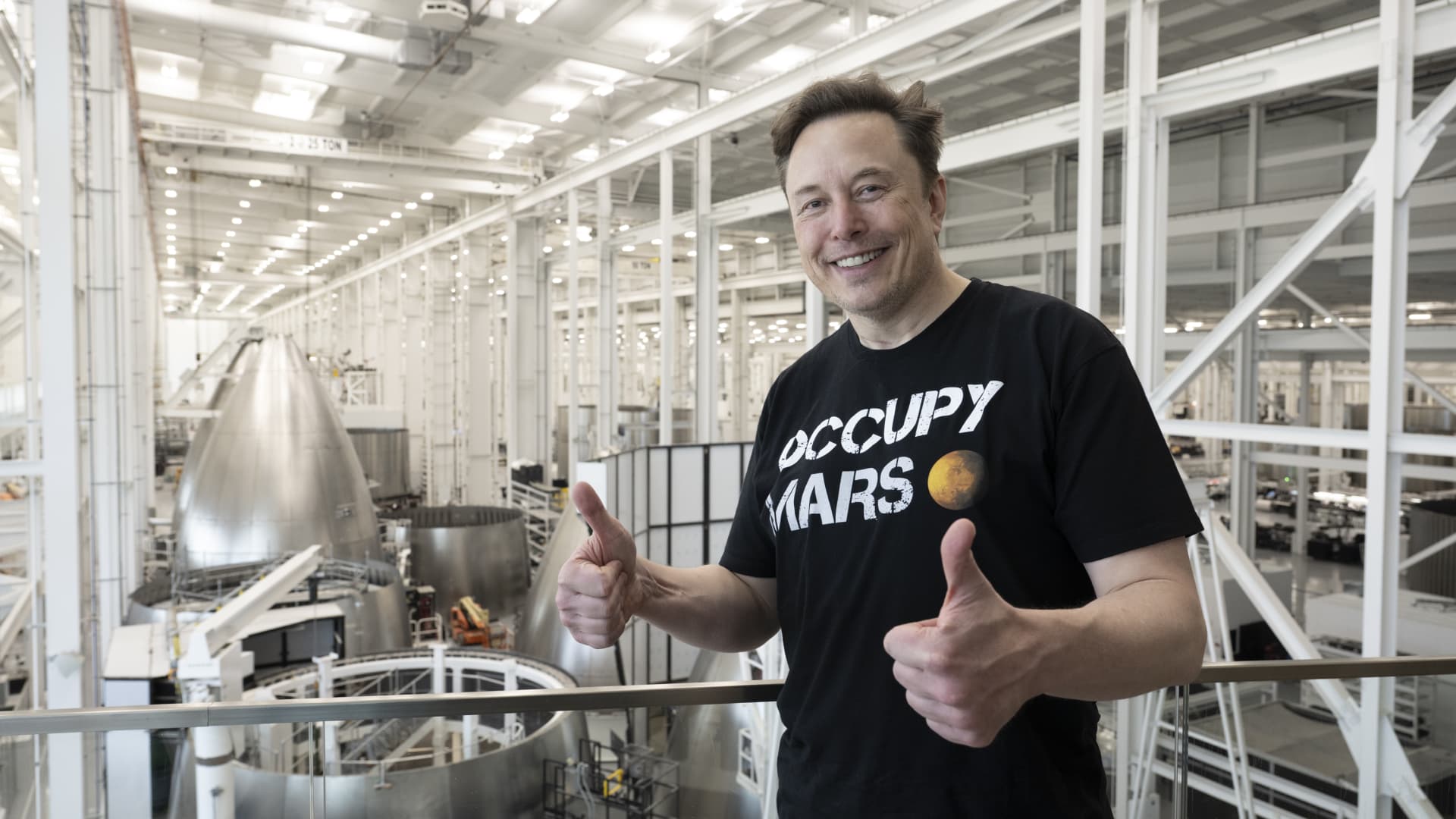
Elon Musk founded SpaceX in 2002. He remains in command after the listing: as chief executive, chief technical officer and chairman, he will hold a minority of the equity but around 85 per cent of the voting power, through high-vote Class B shares that carry ten votes each against one vote for the Class A shares the public buys [1][10]. SpaceX will therefore list as a “controlled company” under Nasdaq rules, exempt from some board-independence requirements [1].
7. What would actually make it a mistake
Set the loudest objections aside and the real risks are sober ones. The first is reflexivity, and it is the most underappreciated. A high listing price and rapid index inclusion bring in capital cheaply, which funds the AI buildout and the options, which justify the high price. That loop runs beautifully upward and just as efficiently in reverse. If the market's enthusiasm for AI capital spending cools, the same mechanism that inflated the price would deflate it, and the cancellable nature of the anchor compute contracts [1] means revenue could soften at exactly the moment funding becomes dear. The second is concentration in a single person whose time and capital are spread across SpaceX, Tesla, xAI, and more, with all the conflict the prospectus catalogues [1]. The third is simple execution: Starship must work at scale, the data centres must earn more than they cost, and the orbital ambitions must clear physics and economics that remain unproven. The fourth is the governance discount of section six, which is not a risk to the price so much as a permanent feature of what you own.
Notice that none of these is “the multiple is ninety-four times revenue.” The genuine dangers are about durability of revenue, alignment of the controller, the reflexive funding loop, and execution. An investor who declined the offering for those reasons would be on firm ground. An investor who declined it because $1.75 trillion is a big number would be right by accident, having never examined the thing.
Facebook’s early motto was “Move fast and break things.” SpaceX embodies that spirit more literally than most: it is known for the many rockets that have exploded during testing, a reminder both of how hard the underlying engineering is and of how difficult it is to anticipate the pace of the breakthroughs its ambitions depend on.
8. The curse of the new listing
There is a recurring pattern in new listings that any buyer of this one should look at squarely. A great many of the most celebrated technology IPOs of the past decade fell hard once the opening excitement faded. Robinhood lost roughly 90% of its value from its offer price at its low, Rivian and Coinbase fell by similar amounts, Snap and DoorDash dropped more than 80%, Lyft and Uber more than half [26]. These were not obscure failures; they were the hottest deals of their years, priced into enthusiasm and bought by people who believed the story. Some later recovered, but the first chapter after the bell was, again and again, a fall.
The pattern is less a curse than a mechanism, and the mechanism matters here more than usual. A company chooses when to sell, and it sells when conditions favour the seller, which is rarely the cheapest moment for the buyer. The first-day jump that makes the headlines, on average close to 20% of the offer price [27], is a gift to the insiders who were allocated stock, not to the public buying at the open. The larger force arrives later. Most newly listed companies stay locked up for around six months, and SpaceX's arrangement is its own two-tier version: a 180-day lock for most holders, an extended lock of roughly a year for a portion of shares including the founder's, who has no early-release right, and a tranche that can come free earlier on set triggers [1]. When a lock-up lifts, employees and early investors are free to sell, supply arrives, and the price often falls, frequently before the date itself. Uber dropped around 17% as its lock-up approached [28]. This is precisely where SpaceX is exposed. It is floating only about 4% of itself, so the opening price is set by a sliver of the company against feverish demand, and the real test comes when the rest begins to unlock. The bank running the deal has reportedly told investors the shares may well be cheaper six months out [20].
The longer record says the same with more authority. Jay Ritter's study of decades of listings found that IPOs underperformed comparable, already-public companies over the years after they listed, and that the worst returns of all came from companies that went public in high-volume years [27]. That finding is the bridge to the most famous example. In 1999 and 2000, at the height of the dot-com mania, hundreds of companies listed and many doubled or more on their first day; VA Linux rose over 700% in a single session [29]. Within a few years more than half of those companies had failed outright, and the technology index had fallen roughly three quarters from its peak [29]. The lesson was not that the internet was fake. The internet was real, and it remade the world. The lesson was that a flood of listings into a euphoric market is, on the historical evidence, a warning, and that the moment of maximum enthusiasm is a poor moment to pay the maximum price.
It would be dishonest to stop there, because the same era produced the opposite. Amazon listed in 1997 and fell more than 90% in the very crash just described, then went on to compound thousands of times over. Google, Facebook after its own ugly debut, and Nvidia were, at their listings, the buys of a generation. The curse is an average, not a law, and the average is made of many companies that were never going to last and a few that changed the world. The whole bull case for SpaceX is that it sits in the second group: not a Pets.com but an Amazon, a real business with real infrastructure that the market will spend a decade growing into. That case is not absurd. The uncomfortable part is that the investors who bought Amazon at its IPO and the investors who bought the doomed names beside it felt the same conviction at the time, and could not have proved which they held.
So the curse is best read not as a prophecy about SpaceX the company, but as a caution about SpaceX the listing. Two things can be true at once: that this is one of the rare businesses worth owning for a decade, and that the first year of public trading, with a tiny float, a price set rather than discovered, and a wall of unlocking stock ahead, is among the least favourable windows in which to buy it. Whether the company is an Amazon is a question about the next ten years. Whether the opening price is a fair entry is a question about supply, lock-ups and sentiment over the next twelve months. They are different questions, with different answers, and the disciplined reader keeps them apart.
9. The questions worth answering
So, is the valuation really that stupid? The honest answer is that “stupid” is the wrong frame, which is why the publication put the word in the title and then spent the preceding sections taking it apart. The price is not a fact to be dismissed or revered. It is a wager, and like every wager it can be examined rather than waved away.
What survives examination is this. The “loss-making, ninety-four times revenue” objection is measuring a company that is in the process of becoming something else, and the trailing multiple is the wrong instrument for that moment. The compute pivot is real, large, and already under contract, and it is also cancellable, capital-hungry, and entangled with a circular flow of AI money. The price embeds a portfolio of genuine options that deserve neither a forecast nor a zero. And the strongest reason for caution is not the valuation at all; it is the charter, the control, and the reflexive funding loop, the things the loudest objections mostly skip.
This is not a recommendation, and the publication does not make them. It is a set of instruments. Before deciding what $135 a share is worth to you, the questions worth answering are these. What revenue do you believe is durable rather than cancellable, and at what margin? What governance discount would you demand to own a share with one vote against the founder’s ten, and is the price offering you that discount or charging you a premium? And how much of the $1.75 trillion are you paying for things that have not happened yet, and are you comfortable holding that as an option rather than a promise? Answer those honestly, and the question of whether the number is stupid will have answered itself, in whichever direction your own examination takes it.
Sources
[1] Space Exploration Technologies Corp., Form S-1 Registration Statement, U.S. Securities and Exchange Commission, filed and accessed June 2026. Primary source for 2025 revenue ($18,674m), loss from operations ($2,589m) and net loss ($4,937m); 2024 net income ($791m); segment results; the February 2026 xAI acquisition, COLOSSUS and COLOSSUS II; the Anthropic Cloud Services Agreements at $1.25 billion per month through May 2029, terminable on 90 days' notice; the Cursor option; the dual-class structure and controlled-company risk factors; launch-cost history; and orbital AI compute satellites targeted from 2028.
[2] Reuters and Capital.com, SpaceX IPO terms: about $135 per share, 556.6 million shares, roughly $75 billion raised, about $1.75 trillion valuation; first trade 12 June 2026 on Nasdaq under SPCX. https://capital.com/en-int/learn/ipo/spacex-ipo
[3] CNBC, “SpaceX is worth less than half of its $1.75 trillion IPO target, Morningstar says,” 3 June 2026. https://www.cnbc.com/2026/06/03/morningstar-spacex-ipo-target-price-nasdaq.html
[4] Fortune, “We recommend that investors avoid this IPO,” 29 May 2026. https://fortune.com/2026/05/29/spacex-ipo-should-i-buy-bear-case-david-trainer/
[5] Whalesbook, “SpaceX IPO: Valuation Disconnect Meets Governance Reality,” and Seoul Economic Daily on the “fandom listing” controversy and Nasdaq 100 fast-track inclusion, June 2026. https://en.sedaily.com/finance/2026/06/01/spacex-ipo-sparks-fandom-listing-controversy-over-retail
[6] TechCrunch, “Google will pay SpaceX $920M per month for compute,” 5 June 2026. https://techcrunch.com/2026/06/05/google-will-pay-spacex-920m-per-month-for-compute/
[7] Tom's Hardware, “Google signs $920M monthly compute deal with SpaceX,” June 2026. https://www.tomshardware.com/tech-industry/artificial-intelligence/google-signs-usd920m-monthly-compute-deal-with-spacex
[8] KuCoin, “SpaceX Secures $26B in AI Compute Contracts with Google and Anthropic,” and Basenor, “SpaceX Could Hit $60B Revenue Run Rate by End of 2026,” June 2026. https://www.basenor.com/blogs/news/spacex-could-hit-60b-revenue-run-rate-by-end-of-2026
[9] 24/7 Wall St., “Goldman Sachs Predicts SpaceX Revenue Will Surge 100X By 2030,” 4 June 2026. https://247wallst.com/investing/2026/06/04/goldman-sachs-predicts-spacex-revenue-will-surge-100x-by-2030/
[10] TradingKey, “SpaceX IPO: Musk Controls 85.1% Voting Power, Shareholders Waive Jury Trials and Class Actions,” June 2026. https://www.tradingkey.com/analysis/stocks/us-stocks/261919584-elonmusk-spacex-ipo-tradingkey
[11] MarketWise, “Will SpaceX's Catastrophic Corporate Governance Scare Off IPO Investors?” June 2026. https://marketwise.com/investing/spacex-catastrophic-corporate-governance/
[12] DataCenterDynamics, “Project Suncatcher: Google to launch TPUs into orbit,” and “Elon Musk says SpaceX will be doing data centers in space,” 2026. https://www.datacenterdynamics.com/en/news/elon-musk-says-spacex-will-be-doing-data-centers-in-space/
[13] CNBC, “SpaceX-Tesla merger chatter reignites,” and Fortune on the merger odds (Dan Ives of Wedbush at 80 to 90 per cent; prediction markets lower), May to June 2026. https://www.cnbc.com/2026/05/26/spacex-tesla-merger-chatter-reignites-as-musk-rocket-company-nears-ipo.html
[14] Autoblog, “Elon Musk Says Tesla's Robot Could Matter More Than Its Cars,” with reporting that Tesla is winding down Model S and Model X production to free capacity for Optimus, 2026. https://www.autoblog.com/electric/elon-musk-says-teslas-robot-could-matter-more-than-its-cars
[15] Fortune, on Super Micro's Charles Liang and the construction of xAI's Colossus in 122 days, and Entrepreneur, “Nvidia CEO Jensen Huang Praises Elon Musk, xAI” for the “superhuman” build speed, 2025. https://fortune.com/2025/03/14/super-micro-ceo-charles-liang-elon-musk-xai-grok-nvidia-server-chips/
[16] Introl, “xAI Colossus Hits 2 GW: 555,000 GPUs, $18B, Largest AI Site,” January 2026, with SemiAnalysis on Colossus 2 as the first gigawatt-scale data centre in the world. https://introl.com/blog/xai-colossus-2-gigawatt-expansion-555k-gpus-january-2026
[17] A million orbital AI data-centre satellites, DataCenterDynamics, 2026. https://www.datacenterdynamics.com/en/news/spacex-files-for-million-satellite-orbital-ai-data-center-megaconstellation/
[18] NASA: SpaceX to land the next Americans on the Moon. https://www.nasa.gov/humans-in-space/nasa-awards-spacex-second-contract-option-for-artemis-moon-landing/
[19] SpaceX, Starship: Mars and point-to-point Earth transport. https://www.spacex.com/vehicles/starship
[20] Bram Berkowitz, “Did Anthropic and Google Just Give Investors 2.2 Billion Reasons to Buy the SpaceX IPO?”, The Motley Fool, 7 June 2026. https://finance.yahoo.com/markets/stocks/articles/did-anthropic-google-just-investors-195843785.html
[21] xAI, “Colossus”, with Introl on the 2 GW, 555,000-GPU Memphis build, 2026. https://x.ai/colossus
[22] Space.com, “SpaceX shatters its rocket launch record: 165 orbital flights in 2025”, 2026. https://www.space.com/space-exploration/private-spaceflight/spacex-shatters-its-rocket-launch-record-yet-again-167-orbital-flights-in-2025
[23] SpaceX Starbase and NASASpaceFlight on the Starfactory and Gigabay; Starbase incorporated as a city, May 2025. https://en.wikipedia.org/wiki/SpaceX_Starbase
[24] Fortune, “SpaceX's $80 billion IPO has a catch: 78% of the money is already spoken for”, 28 May 2026. https://fortune.com/2026/05/28/spacex-elon-musk-ipo-money/
[25] Anysphere (Cursor), on annual recurring revenue from about $100 million in early 2025 to roughly $2 billion by February 2026. https://en.wikipedia.org/wiki/Anysphere
[26] CNBC, “Tech's latest IPOs are getting demolished: Robinhood, Rivian and UiPath down over 70% from offer price”, 2022, and subsequent drawdown data. https://www.cnbc.com/2022/05/09/techs-latest-ipos-fall-with-robinhood-rivian-uipath-down-over-70percent.html
[27] Jay R. Ritter, “The Long-Run Performance of Initial Public Offerings”, Journal of Finance (1991), and updated IPO long-run and underpricing statistics. https://site.warrington.ufl.edu/ritter/files/IPOs-long-run-returns-on-IPOs.pdf
[28] On IPO lock-up expiry and insider selling; Uber fell about 17% around its 2019 lock-up. https://www.schwab.com/learn/story/what-is-ipo-lockup-period
[29] Dot-com bubble: IPO volumes in 1999–2000, the share of listings that later failed, and the Nasdaq's fall from its peak. https://en.wikipedia.org/wiki/Dot-com_bubble
[30] Bloomberg, reported via Yahoo Finance, on the SpaceX IPO being well oversubscribed, with an order book reported near $150 billion against about $75 billion offered, June 2026. https://finance.yahoo.com/markets/stocks/articles/spacex-ipo-said-well-oversubscribed-154906500.html
[31] On the 2026 SpaceX, OpenAI and Anthropic IPO pipeline; OpenAI filed confidentially in May 2026 (around $852 billion), Anthropic in June 2026 (around $965 billion), both with autumn 2026 listing windows reported. https://www.ig.com/en/news-and-trade-ideas/spacex-openai-anthropic-2026-ipo-deals-260520
[32] Reuters, “SpaceX IPO demand is approaching four times oversubscribed, source says,” 9 June 2026. https://www.reuters.com/world/spacex-ipo-demand-is-approaching-four-times-oversubscribed-source-says-2026-06-09/
[33] SatNews, “SpaceX Debuts Starship V3: Redefining Heavy-Lift Launch Capability,” 14 May 2026. https://satnews.com/2026/05/14/spacex-debuts-starship-v3-redefining-heavy-lift-launch-capability/
[34] SpaceNexus, “Space Launch Cost Comparison 2026: Prices by Vehicle and Provider.” https://spacenexus.us/guide/space-launch-cost-comparison