The price is the one hard fact. In March 2026 WHOOP raised 575 million dollars at a valuation of 10.1 billion, in a round led by TPG. That is nearly triple the 3.6 billion the company was worth in 2021. Everything else that would justify the number is harder to see, because WHOOP is private, discloses little, and is not obliged to publish the figures a public investor would demand.
So this piece does something deliberately narrow. It separates the price, which is public and verifiable, from the business, which is mostly not. The gap between the two is the whole subject. WHOOP built a company on measuring people's health statistics. The Socratic move is to turn the same scrutiny back on the company, and to be honest about where the instruments run out.
This is editorial analysis, not investment advice, and nothing here is a recommendation. WHOOP is privately held, so there is no security a reader could act on in any case. The point is the method, not a verdict.
What follows
1. What WHOOP is, and how it got here
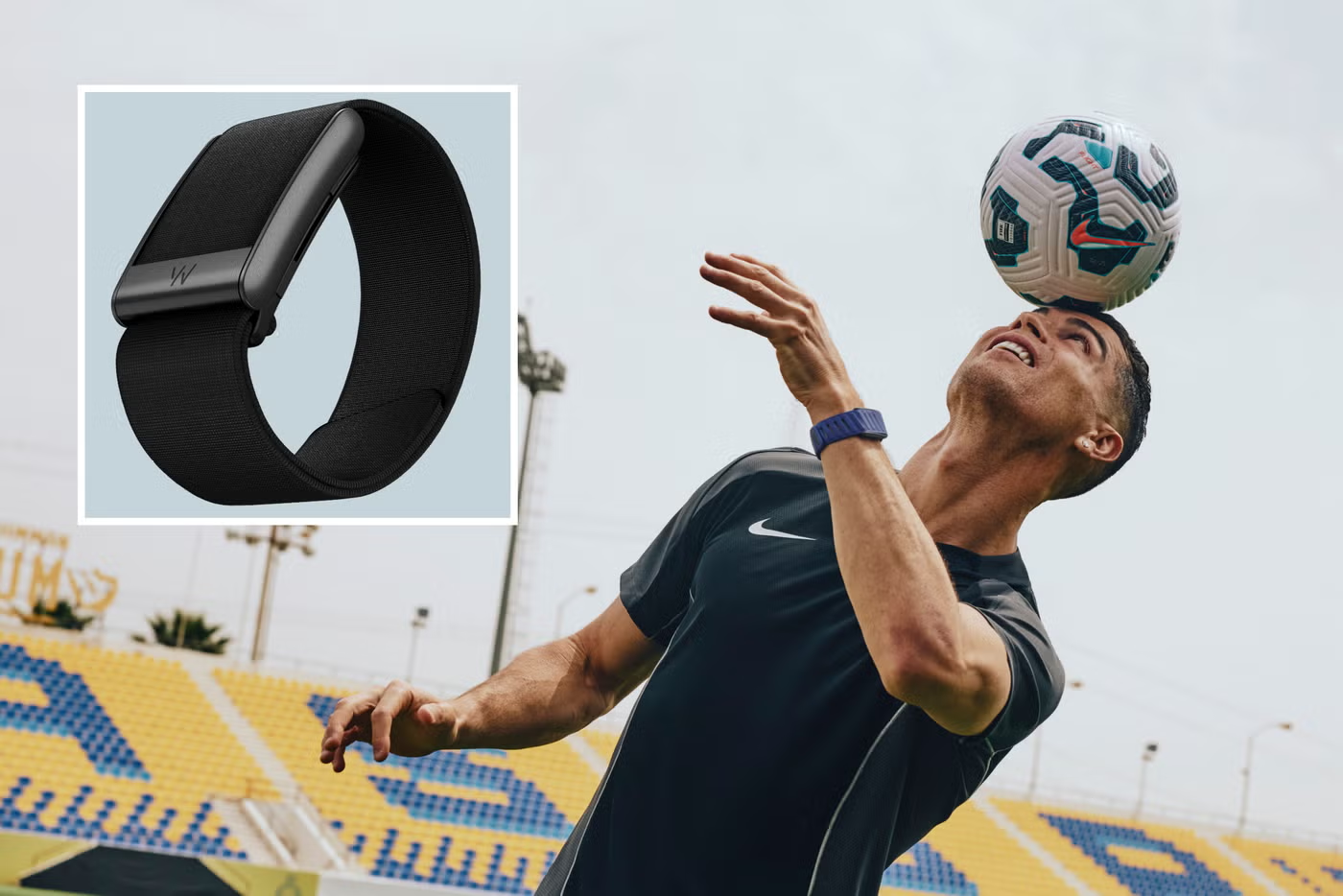
WHOOP makes a screenless band, worn on the wrist or inside its own apparel, that tracks heart rate, heart-rate variability, sleep, and what it calls strain and recovery, then turns those readings into daily coaching through an app. The defining commercial fact is not the hardware. You do not buy the device. You subscribe, and the band is included in the membership. That single design choice is the entire investment thesis in miniature, and it is worth holding onto, because everything later in this piece tests one part of it.
The company was founded in 2012 by Will Ahmed at the Harvard Innovation Labs, with co-founders John Capodilupo and Aurelian Nicolae, out of a squash player's question about how to train hard without breaking down. The first device shipped around 2015. For its first years WHOOP sold hardware outright, for roughly 500 dollars, and struggled. In 2018 it made the move that defines it: it dropped the hardware price to zero, bundled the device into a membership of about 30 dollars a month, and reported that user growth jumped more than 400 percent in the first year. A one-time gadget sale became a recurring subscription, which is precisely why investors can argue today for a software-style valuation on a company that ships physical objects.
It nearly did not survive to make that argument. By 2017 the company was, in Ahmed's own telling, within days or weeks of bankruptcy, after 143 investors had said no and long stretches with only a few months of cash. That history matters in both directions. It tempers the bull case, because this is a company the market repeatedly judged unviable, and it tempers the bear case, because the market has been wrong about WHOOP before.
The brand is built on athletes. LeBron James and Michael Phelps were users as early as 2015, and the roster now runs through Cristiano Ronaldo, Patrick Mahomes, Rory McIlroy, and others. In the 2026 round several of them became investors, and the company is careful to frame them as long-term users rather than paid endorsers. That framing deserves a light touch of scepticism: a celebrity who is now also a shareholder is financially aligned with the brand, which complicates the word authentic. The aspirational, athlete-led identity is a real asset. It is also, as a later section will show, a fragile one.
The product line has climbed steadily upmarket: WHOOP 4.0 in 2021 added health monitoring, and WHOOP 5.0 and WHOOP MG in May 2025 added an electrocardiogram, a contested blood-pressure feature, a longevity score called Healthspan, and a blood-testing add-on called Advanced Labs. The direction of travel is clear. WHOOP wants to be less a fitness strap and more a medical platform, because medical platforms command higher multiples than straps.
WHOOP is, at bottom, a bet that a wellness subscription bundled with a sensor can earn software economics, and a software valuation. Every section that follows tests one piece of that bet.
2. What ten billion implies
Start with the arithmetic the price forces on you. At a publicly reported membership of around 2.5 million and an annual bookings run rate of roughly 1.1 billion dollars, a 10.1 billion valuation works out to about four thousand dollars of company value for every member, and to a multiple in the high single digits on bookings, rising toward the high teens on the revenue the company actually recognises, which independent analysts put below the bookings figure. These are software multiples, applied to a business whose costs still include manufacturing, shipping, and returns.
The valuation did not drift there. It leapt. WHOOP roughly tripled its private mark in five years, and it did so in the same window that its closest comparison, Oura, more than doubled. A re-rating that fast is not a fact about a business so much as a fact about a market's appetite, and appetites change.
3. The comparison that travels
A number on its own says little. Set beside its peers, it starts to speak. Three comparisons are worth making, and only one of them flatters WHOOP.
Oura, the smart-ring maker, was valued at 11 billion dollars in October 2025, roughly doubling from a year earlier, and has filed confidentially for a public listing. It is the cleanest live comparison: similar promise, similar premium, a step ahead toward public scrutiny. Garmin is the awkward one. It is public, profitable, has been selling sports wearables for decades, and carries a market value in the region of 40 billion dollars on revenue many times WHOOP's. A reader is entitled to ask how a loss-making, single-product private company can be worth a quarter of a profitable incumbent with a far larger business beneath it.
And then there is Fitbit, which is the most instructive precisely because it no longer has a price of its own. Fitbit was the pioneer of this category. It went public in 2015, then de-rated as competition arrived, and was bought by Google in 2021 for 2.1 billion dollars. The company that once defined the consumer wearable now sells for about a fifth of WHOOP's current private valuation, and Google has since folded its smartwatch line into the Pixel Watch. The pioneer's arc is the warning every wearable valuation should be measured against.
4. The commoditisation problem
Here is the part that should worry a holder of the bull case the most, because it is the part with the most public evidence behind it. Walk into the market today wanting to track sleep, strain, recovery, and heart-rate variability, and you face a crowd of devices that all claim to do roughly the same thing. A reviewer recently lined four of them up against a Polar H10 chest strap, the validated reference that agrees with clinical electrocardiograms at better than 0.99 correlation. Three of the four were one-time purchases. WHOOP was the only subscription.
The prices tell the story. An Amazfit Helio Strap costs 99 dollars once, with no subscription required. A Polar Loop is 199 dollars once. A Hume Band is 249 dollars once. A WHOOP runs 239 dollars every year, and the device stops working if you stop paying. Run that forward and the gap compounds: over three years a WHOOP costs around 717 dollars, against 99, 199, or 249 dollars one time for the others.
WHOOP is not buying that premium with superior accuracy. Against the chest strap, reviewers found its raw wrist heart rate wobbles during high-intensity intervals, and some users report that the 5.0 reads worse than the older 4.0. The company's fair answer is that raw heart rate is not the product, the recovery and strain model is, and that the model holds up even when the underlying signal is noisy. That defence is reasonable. It also moves the entire justification for the price onto software, brand, and interpretation, which is the worst possible ground to stand on in 2026.
Because interpretation is exactly what is being commoditised. In May 2026 Google launched the Fitbit Air, a screenless tracker at 99 dollars with no subscription, paired with a Gemini-powered AI health coach and a rebuilt Google Health app, and reviewers immediately called it a WHOOP killer. OpenAI's ChatGPT Health and Microsoft's Copilot Health now ingest data from Apple Health and other apps and return the kind of coaching that used to require a dedicated subscription. The very Health Operating System story WHOOP tells to justify a software multiple is the same force that could hollow it out, because if the coaching layer becomes free and neutral, the defensible part of WHOOP shrinks to the sensor, and a company that becomes a sensor feeding someone else's AI is on the Fitbit path, not the platform path.
Two honest qualifications keep this fair. The cheap substitution mostly bites episodic data, the workouts and steps a phone already sees, not the continuous overnight readings WHOOP specialises in, so an AI sitting on a free app does not fully replace a WHOOP. And the data owners are fighting back: Strava changed its terms in late 2024 to bar third parties from using its data to train or run AI models, and tightened them again in 2026. The substitution is real, but it is not frictionless.
The competitive question, in the wild: a recent review frames Google's screenless tracker as a direct WHOOP rival.
5. What the public cannot verify
The whole premium over a hardware company rests on one idea: that WHOOP's members do not leave. Recurring revenue is only worth a recurring-revenue multiple if it recurs. And here the analysis hits a wall, honestly reported rather than papered over. WHOOP is private. It does not publish its retention curves, its true churn, its customer acquisition cost, its lifetime value, or the unit economics that would let an outsider judge whether the subscription is durable. So the single most important variable in the valuation is the one the public cannot see.
This is not a failure of research. It is the finding. A company is entitled to keep these numbers private, and WHOOP does. But it means that anyone paying a software multiple is paying for a durability they are taking on trust. When the bull case and the bear case meet at the same unverifiable number, the honest conclusion is not a verdict. It is a flag.
The valuation rests on retention. Retention is exactly the number WHOOP does not disclose. The premium, in other words, is an assumption wearing the costume of a fact.
6. The regulator, both ways
WHOOP's medical ambition runs straight into the medical regulator, and the same authority appears as both a tailwind and a risk depending on which way the company points you.
The tailwind is real. In July 2026 the United States begins a ten-year programme, the ACCESS model, that lets Medicare pay for technology-supported chronic-care, and WHOOP is among the more than 150 named participants. That is a genuine door opening. It is also voluntary, outcome-based, unproven, and shared with 150 other organisations, which is a long way from the simple claim that Medicare will fund wearables.
The risk is just as real and tends to go unmentioned in the bullish telling. In July 2025 the Food and Drug Administration sent WHOOP a warning letter over its blood-pressure feature, which the agency considered an unauthorised medical function. WHOOP refused to remove it, a class action followed that leaned on the warning letter, and as of mid-2026 the dispute had not been resolved, even after the FDA loosened its wellness guidance in January. The same regulatory system is the reason to be optimistic and the reason to be careful. A reader should size the Medicare promise as a pilot, not a windfall, and treat the FDA fight as an open question, not a closed one.
7. Two ghosts: Fitbit and Peloton
Two companies haunt this valuation, and they died different deaths. Fitbit is the commoditisation death already described: the pioneer out-sensed and out-distributed, de-rated, absorbed, discontinued. Peloton is the other kind, the hype-cycle death, and it is the more cautionary of the two.
Peloton sold premium hardware wrapped in a recurring subscription and an aspirational, celebrity-driven brand, and told investors it was a membership platform rather than an equipment maker. The market believed it. In January 2021 Peloton was worth about 49 billion dollars, briefly more than Ford, Adidas, and Under Armour combined. Today it is worth around 1.8 billion, a fall of roughly 96 percent, with revenue still declining and four chief executives in under five years. The model that was supposed to make it durable, the subscription, did not save it when growth normalised and churn arrived.
The rhyme is fair: same model, same aspirational brand, same platform-not-hardware story, and a demand surge during the health-and-wellness moment that may have pulled growth forward. But the breaks matter, and one of them matters most. Peloton's rise and fall were a regime, not just a company. The rise rode near-zero rates, trillions in stimulus, and forced stay-at-home demand, a wave that lifted an entire cohort of unprofitable growth names together. The fall was just as macro: the 2022 inflation shock, with consumer prices up more than 9 percent, and the fastest rate-hiking cycle in decades repriced every long-duration asset at once. Attributing the whole collapse to the connected-fitness model misreads it.
That cuts in WHOOP's favour and against the lazy version of the analogy, because 2026 is not 2021, and a Peloton-style macro de-rating is not a given. But the honest move is to turn it into a question rather than an exoneration. Every era has its liquidity engine. The last public bubble ran on stimulus and zero rates. Today's private decacorn valuations run on a different fuel, an AI-and-private-capital cycle willing to pay software multiples for data-and-AI narratives. The real question is not whether WHOOP becomes Peloton. It is which regime is inflating this valuation, and what would deflate it.
For the company's own story and rise, a longer documentary treatment.
8. Priced global, sized American
There is a quieter assumption buried in the words health platform, which is that the platform is global. The public evidence suggests it is, for now, mostly American. WHOOP does not publish a country-by-country split, so this has to be shown with proxies rather than a clean official figure, but the proxies all point the same way. Independent estimates place roughly two-thirds of revenue in the United States. Web-traffic data shows the United States as the dominant source by a wide margin, followed by the United Kingdom and Germany. The company's own feature-availability page reveals that many health functions clear and launch in the United States first and reach other countries much later. And the brand machine runs on American sports.
This does two things at once. It is a concentration risk: a ten-billion-dollar valuation resting largely on one country is a bigger ask than the global framing implies. And it is another instance of the opacity that runs through the whole story, because the absence of an official geographic disclosure is itself part of what the reader is asked to take on faith. The bull's rebuttal, that international revenue is growing fast off a small base, is true and belongs in the picture. It does not change the fact that the company is, today, priced as a global platform and sized like an American one.
Will Ahmed, in a longer founder interview, on building WHOOP. Older, but useful on the company's self-understanding.
What survives examination
This piece does not end with a verdict, partly because the publication does not give them, and partly because WHOOP is private and there is nothing to act on. What it can do is state plainly what would have to be true for ten billion dollars to make sense, and what would tell a reader early if it does not.
For the price to hold, three things have to be true at once. Members have to stay, year after year, at rates the public cannot currently verify. The interpretation layer has to stay differentiated enough to defend a subscription, in a year when Google, OpenAI, and a shelf of 99-dollar devices are all attacking exactly that layer. And the company has to broaden beyond its American, athlete-led base into the global platform its valuation already assumes. Each of those is plausible. None of them is proven, and the company keeps the numbers that would prove them out of public view.
What would tell you early, before any public listing, is mostly watchable from outside. Watch whether WHOOP starts disclosing retention, because companies disclose the numbers that flatter them and stay quiet on the ones that do not. Watch the lifetime-cost gap against the free-after-purchase devices, and whether WHOOP has to cut its subscription to hold members. Watch the FDA dispute, because the medical story is doing a lot of the valuation's work. And watch whether the international base actually broadens, or whether the company stays, in practice, a very good American product with a global price.
The honest conclusion is partly about the limits of what can be known from outside, which is, in the end, the whole point. WHOOP built a business on persuading people to trust a number about themselves they had never examined. The least a careful reader can do is examine the number put on WHOOP, and notice how much of it rests on things that cannot yet be seen.
Sources
- Whoop valuation tripled to 10 billion, Series G, TechCrunch, March 2026.
- WHOOP raises 200 million at 3.6 billion valuation, company press release, 2021.
- WHOOP founder on near bankruptcy and 143 rejections, CNBC, June 2026.
- Series G athlete investors, The National, March 2026.
- Will Ahmed and WHOOP founding, Harvard SEAS.
- Oura reaches 11 billion valuation, CNBC, October 2025.
- WHOOP at 10bn, Garmin at 40bn, the5krunner, April 2026.
- Fitbit statistics and Google acquisition, Business of Apps.
- Fitbit Air, 99 dollar Whoop challenger, CNN Underscored, May 2026.
- Gemini AI health coach for Fitbit, MobiHealthNews, 2026.
- ChatGPT Health, OpenAI, January 2026.
- Helio Strap vs Polar Loop vs Whoop 5.0, TechRadar.
- Polar H10 validity versus ECG, NIH.
- Strava API restrictions on AI, Strava press and Neowin.
- WHOOP FDA warning letter, FDA, July 2025.
- FDA dispute unresolved, STAT, May 2026.
- CMS ACCESS model, CMS.
- Peloton peak versus collapse, Music Business Worldwide.
- Peloton FY2025 revenue and subscribers, Business of Apps.
- whoop.com audience geography, Similarweb.
Socrates on Investing is an editorial publication. This article is for educational and informational purposes only, is not investment advice, and is not a solicitation or recommendation to buy or sell any security. WHOOP is privately held. Figures are drawn from public sources and independent estimates, are approximate, and may change. The author holds no position related to the companies discussed.